


Creativity as a Superpower: Dr. Saurja DasGupta’s Science Communication Toolkit and Graphic Novel
In an age of misinformation and distrust, many scientists are underutilizing a powerful tool for generating interest in their research findings: creativity. Saurja DasGupta, Ph.D., uses his Research!America Public Engagement Content Award to encourage scientists to embrace creative pursuits, namely popular science writing and comic art.
Saurja is an Assistant Professor of Chemistry and Biochemistry at the University of Notre Dame, where he researches RNA’s role in the origin of life. Throughout his time in academia, Saurja has been writing popular science articles to engage with the public. It was during the COVID-19 pandemic that a shift happened: Saurja began to see his science writing as less of a hobby, and more of a requirement. He realized that the skill of effectively communicating science to the public had to be woven into his job.
However, science communication needs to be approached in the right way to ensure engagement from non-scientists.
“It cannot come from top-down as an instruction [where]…we’re telling you what to do,” Saurja explains. “That’s always taken badly. It has to come from a place of love, and beauty, and appreciation for science and how cool it is.”
Saurja is developing a “A Science Communicator’s Toolkit” to teach graduate students and postdocs how to lean into this concept. The toolkit is still in the works, but currently broken into three modules: writing, art, and social media. The writing module is a partnership with Club SciWri, and consists of eight lectures.
The power and influence of a standalone popular science article should not be underestimated. However, combining art with written text can generate an even further reach. Saurja has seen this firsthand with the ongoing creation of his graphic novel on the origin of life.
“Comics capture the narrative that a popular science article has, but also [have] pictures in [them],” Saurja says. “[They have] the best of both worlds.”
Saurja first had the idea for a graphic novel on life’s beginnings when he noticed the prevalence of origin stories in comics. According to Saurja, the origin of life is an excellent topic for a science comic because researchers don’t know what Earth looked like 4 billion years ago. What color was our Earth? What did the bodies of water look like? What was Earth’s atmosphere made up of? These are questions scientists still grapple with, leaving a lot up to the imagination.
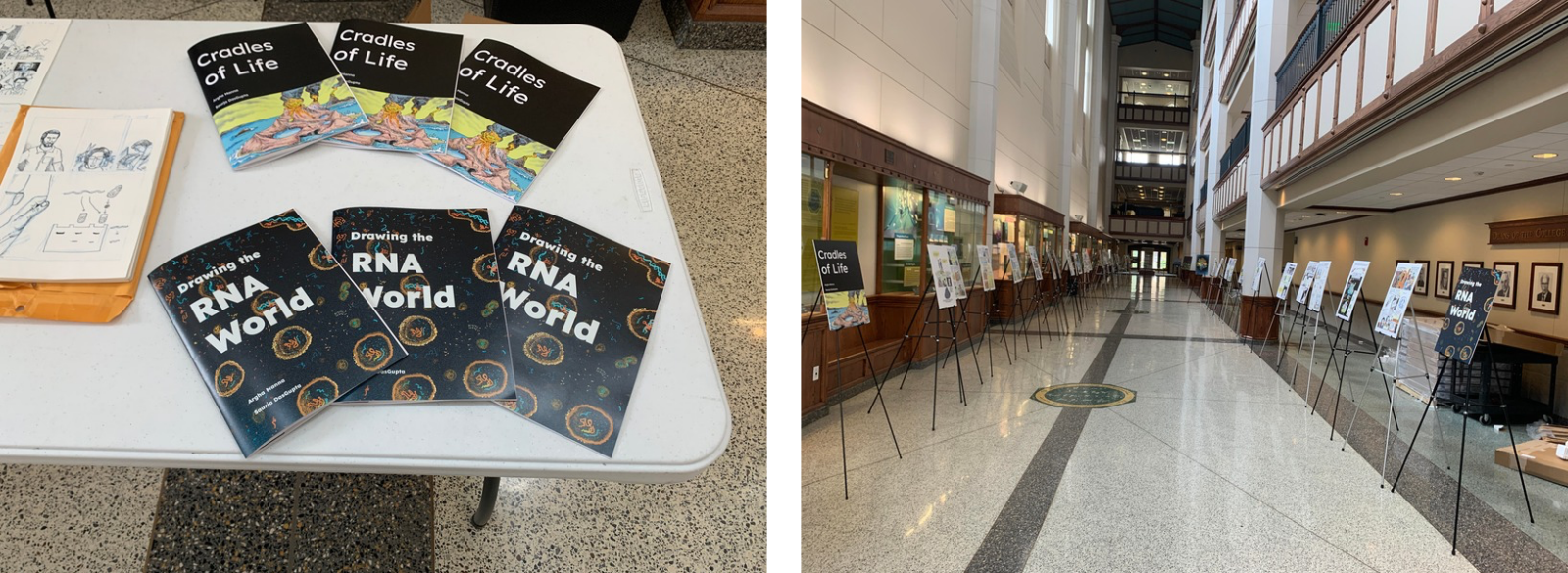
In a similar vein to Plato’s Phaedrus, in which Socrates and Phaedrus engage in conversation about philosophical concepts, Saurja’s graphic novel will explore the origin of life through dialogue between two characters. He began collaborating with Argha Manna, a biologist turned illustrator, to take his comic from bits of dialogue to a fully-fledged body of work. They have exhibited the first few chapters of the graphic novel at lectures, panels, and conferences, reaching people of all ages, from 6 to 80 years old. The feedback has been overwhelmingly positive, with one young scientist even using the comic book to make a school science fair project.
While the graphic novel is being created with the public in mind, Saurja hopes scientists will use the work to close any gaps in knowledge. The comic spans topics such as biochemistry, geochemistry, astrobiology, and microbiology, so no matter their expertise, there’s something new for them to learn. Perhaps more importantly though, scientists can use the graphic novel as an example of how to communicate science through a creative and inviting medium.
In Saurja’s opinion, creativity – whether it be writing, art, content creation, or something else entirely – is the Rosetta stone for complex scientific topics.
“If we can tell science as a story, especially with figures, especially with art…it makes things so much easier.”