


Did You Know? From Living Dinosaur to Miracle Drug
Even after a decade as a biologist, I am still amazed by the almost incomprehensibly diverse ways that animals all around us have adapted to survive. Microscopic water bears (tardigrades) live in the moss in your neighborhood park and can survive temperatures up to 300F or live dormant for decades; mantis shrimp can punch their prey with the acceleration of a speeding bullet; and cockroaches can regrow their limbs. The world around us is wily and scrappy, and there is so much left to learn, not just about these amazing animals, but also how they may hold the secrets to improving our own health. The discoveries we make today can become tomorrow’s medical breakthroughs.
Today I’d like to take a moment to share the story of how revolutionary weight-loss drugs were developed after decades of research into scaly lizard monsters and their weird eating habits.
Meet the Gila Monster
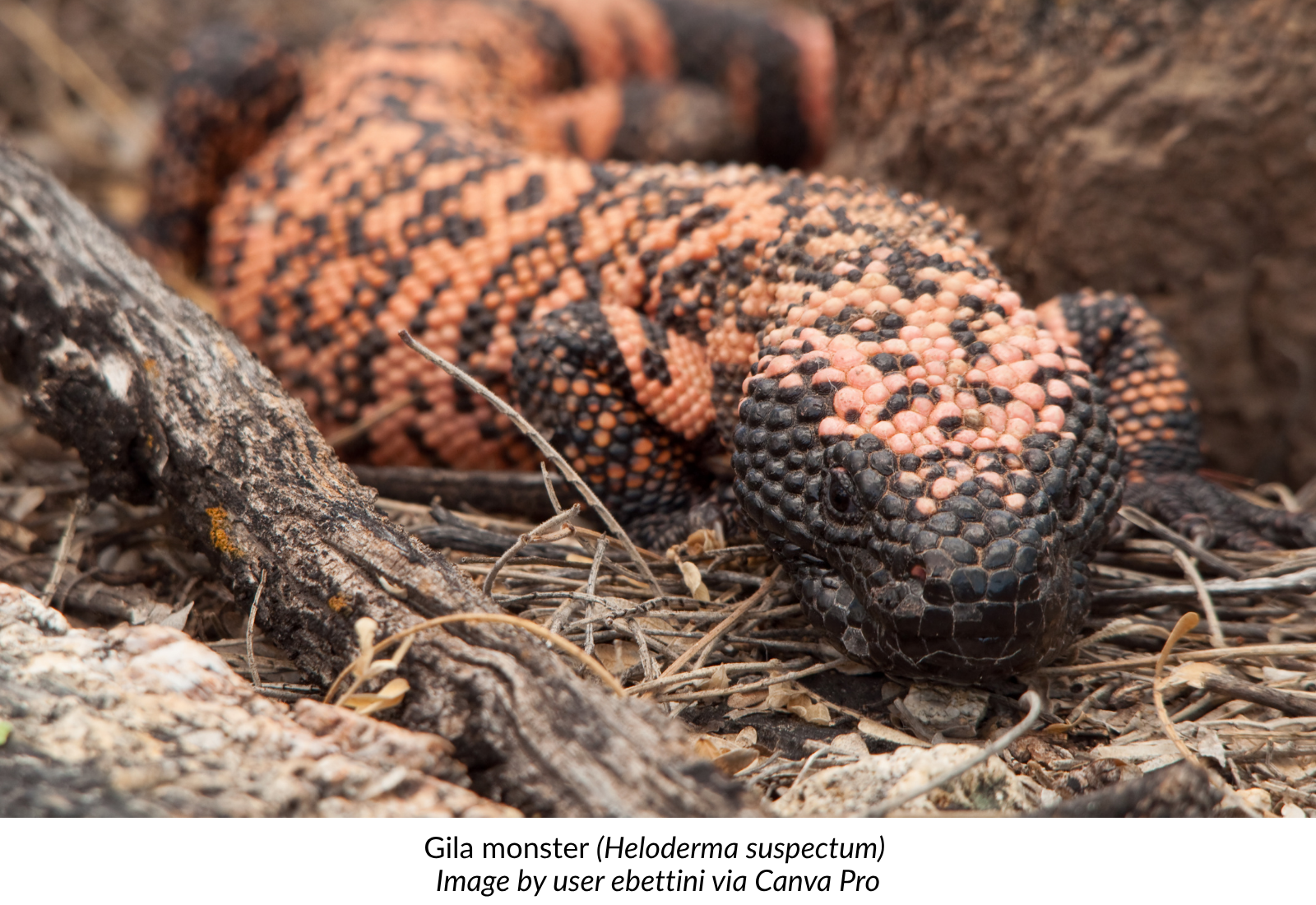
The Gila monster (Heloderma suspectum) is the largest and only native venomous lizard in the U.S., measuring up to 22 inches. It is also (I suspect) a lover of all things Halloween, as its scales are black and orange.
If you’ve never seen a Gila monster in the wild, that’s not surprising. Gila monsters spend most of their time underground in the Southwestern deserts of North America. Through research partially funded by the National Science Foundation (NSF), we know that Gila monsters only need to eat three or four large meals a year! And by large, I mean that they will eat prey that are almost a third of their own weight. They are then able to live off fat stored in their tails.
From Unique Eating Habits to Medical Breakthroughs
Decades of research into Gila monsters—tracking their behavior, studying their venom, and cataloging their samples, laid the groundwork for unexpected discoveries. Researchers at the Veterans Administration discovered that compounds in the Gila monster venom contained a peptide (exendin-4) that is similar to a hormone in the human gut (GLP-1), which is released after eating and helps regulate satiety (the feeling of fullness) and blood glucose levels. This finding further explained how Gila monsters are able to wait so long between meals. Later, researchers discovered that exendin-4 lasted much longer than the GLP-1 hormone typically produced by the body, from mere minutes to hours.
This discovery opened the door for a wave of drug development that required immense financial investment from both the federal government and private industry, and enabled researchers to refine GLP-1-like drugs, test different versions, and create treatments for both diabetes and weight loss. Fast forward to today and we now have several GLP-1 drugs on the market that that have transformed care for millions of Americans with obesity or diabetes. To date, over 5,000 grants funded by the National Institutes of Health (NIH) are related to GLP-1. This remarkable explosion of research would not have been possible without immense financial investment from both the federal government and private industry.
The discovery of a drug does not exist on an island. It requires hundreds of researchers all asking questions and testing hypotheses. It requires identification of the compounds in the gut that are responsible for sugar breakdown. It requires an understanding of insulin secretion, insulin sensitivity, and eventually diabetes. And sometimes it requires surreptitious discoveries about a scaly little friend that only eats a few times a year, and lives underground.
So, the next time you’re on a nature walk, or simply out in your garden, look around and give a nod of thanks. There’s no telling what other medical discoveries might be waiting all around you, even in the venom of an ugly “living dinosaur.”