

The Unique Influence of Humor on Communicating Science
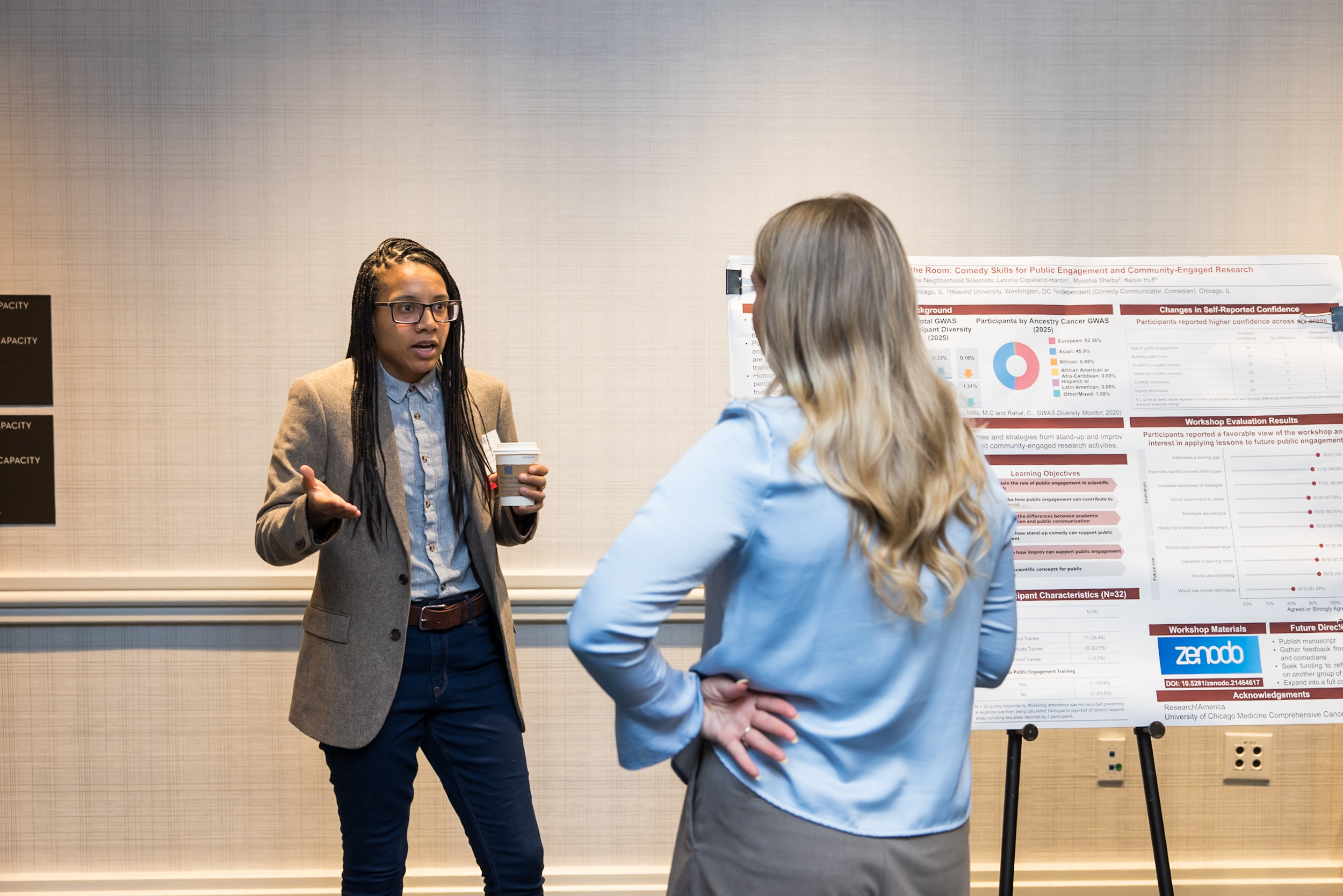
Letonia Copeland-Hardin, Ph.D., has been interested in comedy since she was nine years old. She began performing at open mics during graduate school as a form of stress relief. After receiving Research!America’s Public Engagement Content Award, she was able to bring that love of humor into her research at the University of Chicago.
As a genomics researcher in the Department of Public Health Sciences, Letonia examines how environmental exposures impact gene expression. Through her postdoctoral studies, Letonia was introduced to community-engaged research, a form of public engagement that involves community partners in every step of a research study, from developing an idea to sharing the results.
“What’s interesting is that on some level, I had already been doing public engagement informally and unintentionally as a stand-up comic,” Letonia says. “Some of my material is about science and my life as a scientist.”
After attending a talk by Sara K. Yeo, Ph.D. – whose research suggests that comedy can be an effective tool for earning trust and increasing likeability – Letonia recognized the very clear overlap between the techniques needed for comedy, and the techniques needed for community-engaged research. She began collaborating with geneticist and translational neuroscientist Myeshia Shelby, Ph.D., and comedy communicator Kelsie Huff on a curriculum for graduate students and postdoctoral scholars that explores this overlap.
Community-engaged research is meant to be collaborative and thus requires trust between the scientist and the participants.
“This is something that has to be addressed before we can even begin working on research projects together,” Letonia explains.
Fostering trust can take time, especially for marginalized communities, whose mistrust and skepticism stem from both a history of racism and sexism in the medical field and past experiences with helicopter research studies (studies conducted on communities without their input), which are extractive. When trust is not built, a lack of representation in medical research persists, potentially widening existing health disparities.
Joke-telling, one of the comedy techniques that can help build this trust, involves taking a complicated story and turning it into something the audience understands very quickly at the punchline.
“Making information accessible…is definitely a skill that comics have to master,” Letonia adds.
Community-engaged researchers need to employ the same skill. Direct collaboration between scientists and non-scientists requires the translation of complex, technical concepts. Through a one-day workshop, Letonia, Myeshia, and Kelsie teach scientists how to use joke-writing formulas to explain these concepts in a more compressible way.
Improv comedy’s “yes, and” rule is another technique covered in the curriculum. “Yes, and” refers to the core principle of improvisation, in which a performer must always embrace their scene partners’ ideas without question (“yes”), and then build on the idea by adding new details (“and”). Letonia explains that in academic settings, if someone expresses a concern that is not rooted in science, scientists often prioritize correcting the misinformation.
“In a community-engaged research setting, you should acknowledge the concern,” Letonia says. “You’re ‘yes’-ing the concern. It doesn’t mean you’re ‘yes’-ing the misinformation. And then with the ‘and,’ you’re [able] to proceed with facts.”
This technique helps create a mutually respectful and collaborative research environment.
Regarding Research!America’s Public Engagement Content Awards program, Letonia says: “One of the most rewarding parts of the experience has been connecting with other micrograntees and awardees who share our belief that science communication should be a core part of a researcher’s role. [It] has been reassuring and inspiring.”
In case you missed it, Letonia was recently featured in the Chicago Tribune for her unique take on engaging the public in research through humor.