

An Important Step Forward
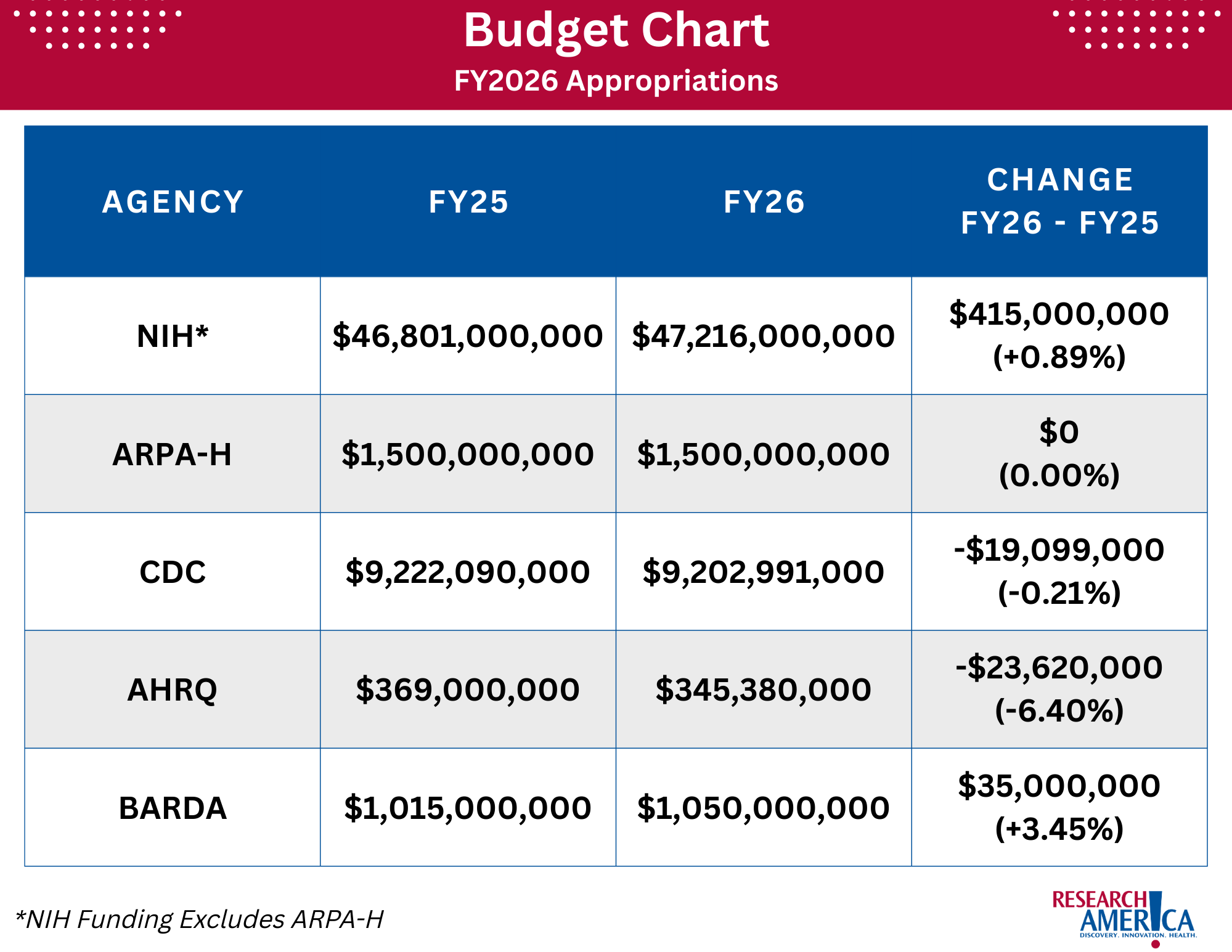
This week, House and Senate appropriators released a bipartisan, bicameral funding package that includes the Departments of Labor, Health and Human Services, Education and Related Agencies (L-HHS) bill and the L-HHS Joint Explanatory Statement. Notably, the package increases NIH funding by $415 million (+0.89%), an outcome that exceeds both the House and Senate levels.
Advocacy and Outcomes: Your advocacy – whether you took action or supported action – helps explain this outcome. We are not at any finish line. The package is not yet signed into law, and if it does become law, we have much more work to do as evidenced by the funding cuts noted below. But it’s not too soon to thank you for what you do and for your partnership…and to thank congressional champions and their staff members for accomplishing the near-impossible: see our statement.
More Details: Funding outcomes for other research agencies include:
- ARPA-H is flat funded at $1.5 billion
- BARDA is increased by $35 billion (+3.5%)
- AHRQ is cut by $23 million (-6.4%)
- CDC is cut by $19 million (-0.2%)
 The package includes language limiting the amount of funding NIH can use for multi-year grants and other financial mechanisms. (Last week’s letter discussed the negative impact of a rapid shift to multi-year funding.) It also maintains the current prohibition on changes to indirect cost reimbursement, preserves NIH’s institute and center structure, and requires NIH to notify Congress prior to terminating grants.
CDMRP Funding: The Defense appropriations bill in the package contains funding for the Congressionally Directed Medical Research Programs (CDMRP). Again, your advocacy helped achieve a significant $620 million – or 95% – increase over FY25. The new funding level restores most of the FY25 funding cut, which is incredible progress given the current funding environment. To find FY26 funding levels for specific CDMRP funding lines, use our new CDMRP budget chart.
R&D-related Health Provisions: The agreement includes the Mikaela Naylon Give Kids a Chance Act, a package of important health provisions including reauthorization of the Rare Pediatric Disease Priority Review Voucher program. The agreement also creates a much needed pathway for coverage of multi-cancer screening tests, which is essential not only for early detection today, but to ensure continued progress in next-generation diagnostics.
The House passed the package late this afternoon. Barring snow-related delays, we anticipate that the Senate will pass the bill next week ahead of the Jan. 30 funding deadline. (Don’t quote us! This is just a forecast.)
Important International Research Partnerships Update: NIH has released a new Notice of Funding Opportunity formally initiating a pathway for research partnerships that had previously included foreign subawards. Applications will be accepted to many NIH institutes and centers beginning April 25.
Defeating Alzheimer’s Disease: The number of Americans with Alzheimer’s disease or a related dementia has grown to 7 million – more than the populations of New Hampshire and Iowa combined. That’s not just a wake-up call; it’s a siren. If you live in the D.C. area or your travel plans permit, save this date and time – Feb. 11, at noon ET – for a Capitol Hill briefing focused on progress, achieved and needed, in the early detection and treatment of Alzheimer’s disease. Check out next week’s letter for registration information.
(If you missed the Hill briefing we held yesterday focused on one of the deadliest and costliest mistakes in health policy, the dramatic under-funding of health services research (HSR), check out this infographic for a quick HSR explainer.)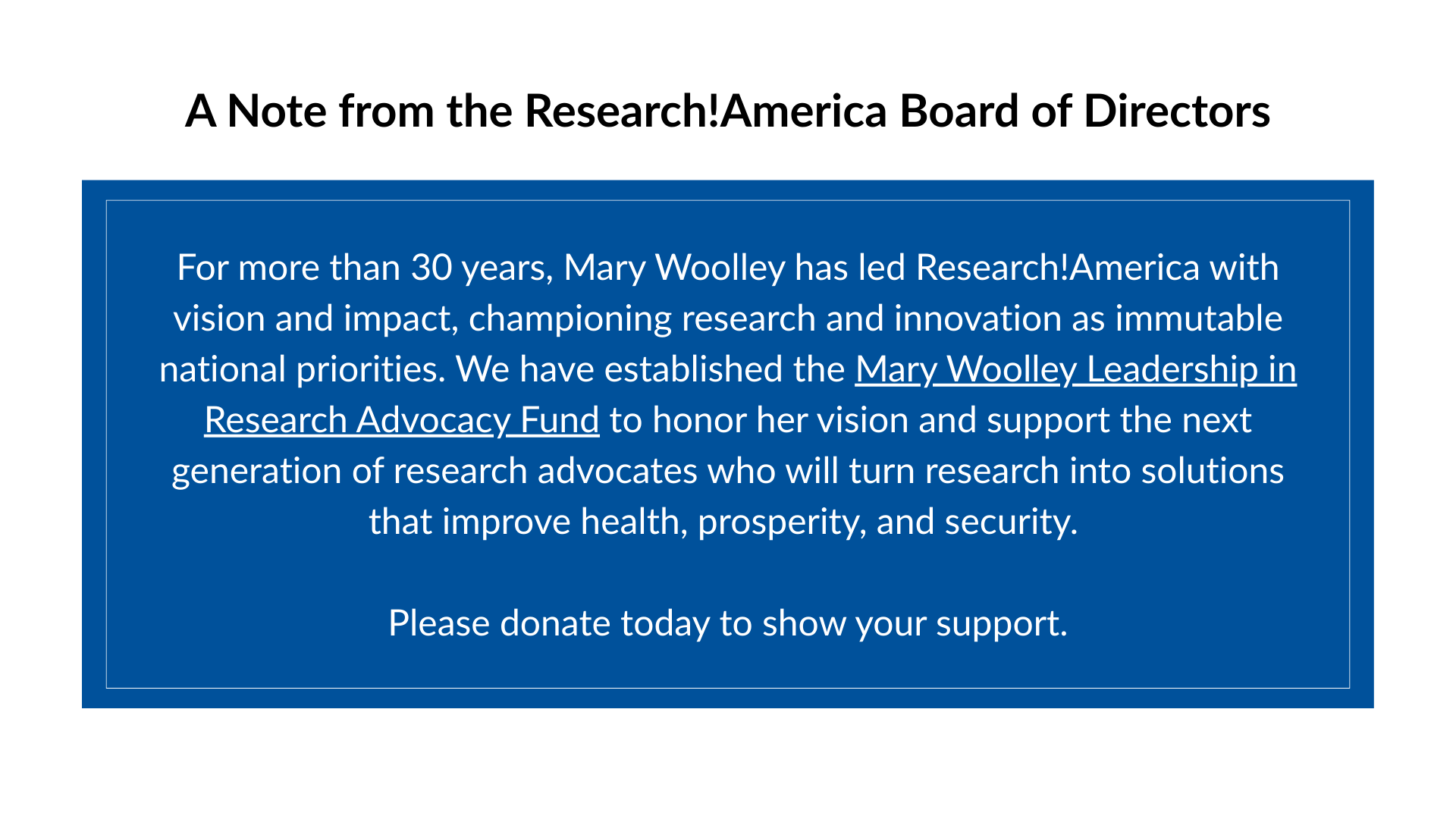 Calling all Research!America members: We want to hear from you! Our 2026 membership survey has been sent to the primary contact at each of our member organizations. Thank you to those who have already participated. We hope even more members will complete the survey by Jan. 31. Please contact Donald Cook, Associate Director of Membership and Development Operations, if your organization would like to complete the survey. Your responses inform our advocacy and programming – and we look forward to providing you with even more value.
*Ellie Dehoney, Research!America’s Senior Vice President of Policy and Advocacy, is our guest author this week.