

Public Engagement Cannot be Optional
I am truly humbled by the response I’ve received in the two weeks since I delivered remarks while accepting the John Edward Porter Legacy Award at Research!America’s 2026 Advocacy Awards event in Washington, D.C.
Fellow advocates have let me know they heard and appreciated the pointed message: There was a time when the scientific community could afford to remain largely in the background and still anticipate taxpayer support. That time has passed.
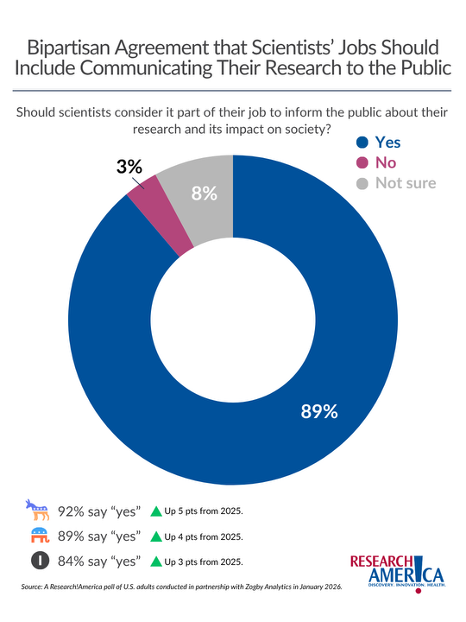 The public wants scientists to engage: nearly 90% of respondents to the national public opinion survey we commissioned in January say scientists should consider it part of their job to inform the public about their research and its impact on society. Yet, only about 25% of Americans can name a living scientist.
Empowering Engagement: Among the ways Research!America is working to build closer ties between scientists and non-scientists is through our Civic Engagement Microgrants. Since 2018, we have worked with more than 150 groups of early-career researchers on outreach initiatives in 40 states.
Our newer Public Engagement Content Awards fund the development of open-access curricula in the various skills needed for effective public engagement.
Congratulations to the recipients of our 2025-2026 microgrants and content awards announced earlier this week. They are putting the visibility of science into practice and are spurring others to do the same! I encourage you to read about the terrific lineup of projects. Visit our Microgrant Program webpage here and the Public Engagement Content Awards program webpage here.
Public Engagement Impact: One of our former Civic Engagement Microgrant recipients, UNC-Chapel Hill early career researcher JP Flores, recently published an op-ed that also makes the case for scientists to reach out and engage with their communities. JP states, “If science is meant to serve the public, then public engagement cannot be optional.” (Read the full op-ed here.)
Public Witness Testimony and Other Deadlines: A few key deadlines are coming up. The House Labor-HHS Subcommittee (NIH, CDC, AHRQ, BARDA, ARPA-H) is accepting written public witness testimony through April 16, and the CJS Subcommittee (NSF) through May 8. These submissions are a key opportunity to weigh in directly with appropriators on funding priorities. Read Research!America’s testimony for both subcommittees (Labor-HHS and CJS) and check out our Preparing Written Testimony 101 primer for tips if you’re planning to submit your own.
On the Senate side, appropriations guidance is out, with deadlines including April 14 (CJS and Ag-FDA), April 21 (Labor-HHS), and May 12 (Defense). More office-specific deadlines expected soon. As always, our appropriations tracker has the latest.
The President’s Budget, Plus: Our next alliance member-only meeting will take place on Tuesday, April 7, at 11 a.m. ET. We are thrilled to be joined by Nick Bath, Partner at Manatt, Phelps & Phillips. Nick is a utility player – if the president’s budget is released by then, we’ll dig into it; if not, there are plenty of other critical research and public health advocacy issues to discuss (e.g., updates on AHRQ, FDA, and CDC will be on the agenda, either way). If you are with an alliance member organization, watch your inbox for registration information. If your organization is interested in learning more about membership, check out our website or connect with Donald Cook.
The Multi-sector Path to Medical Progress: As a venture capitalist and former president and CEO of JDRF (now Breakthrough T1D), Research!America Board Member Derek Rapp understands the important roles both public and private sector funding play in achieving medical progress. He connects the dots in this insightful op-ed, originally published in the St. Louis Business Journal. (Subscription required.) You can read his commentary on LinkedIn here.
Alliance Discussion on the Future of U.S. Biotech: Derek’s op-ed largely focused on the role of publicly funded research conducted at research universities, academic health centers, and independent research institutes. Join us on Wednesday, April 1, at noon ET to home in on another key facet of the U.S. R&D ecosystem: the biotech sector. This event is open to the public. Learn more and register here.
Remembering Dr. J. Michael Bishop: Late last week, our nation lost J. Michael Bishop, a tremendous leader and researcher. Dr. Bishop and his fellow laureate, Harold Varmus, shared the Nobel Prize in Physiology or Medicine in 1989 for their discovery of the genetic foundations of cancer. This discovery opened the door for new, life-changing developments in treating cancer. Later, as chancellor of UC San Francisco, Dr. Bishop was a powerful advocate for research funding. He received the National Medal of Science from President George W. Bush, and we were proud to honor him with our Award for Sustained National Leadership in 2011. His list of accolades are richly deserved and his legacy is in lives saved and science advancing apace. We extend our deepest condolences to his family, friends, and colleagues.