

Transitions
 Earlier this week, we announced that Russ Paulsen will become Research!America’s next president and CEO on May 4.
Russ comes to us from his leadership position at UsAgainstAlzheimer’s, a highly influential and impactful patient advocacy organization. That’s the tip of the iceberg of his qualifications; please see our press release, and join me in welcoming Russ to the Research!America team!
Recap: The President’s FY27 Budget Request: On Friday, President Trump released his FY27 budget request to Congress. We’ve created a new budget chart to outline the harmful cuts facing U.S. science, technology, and medical progress.
The president’s budget proposes to: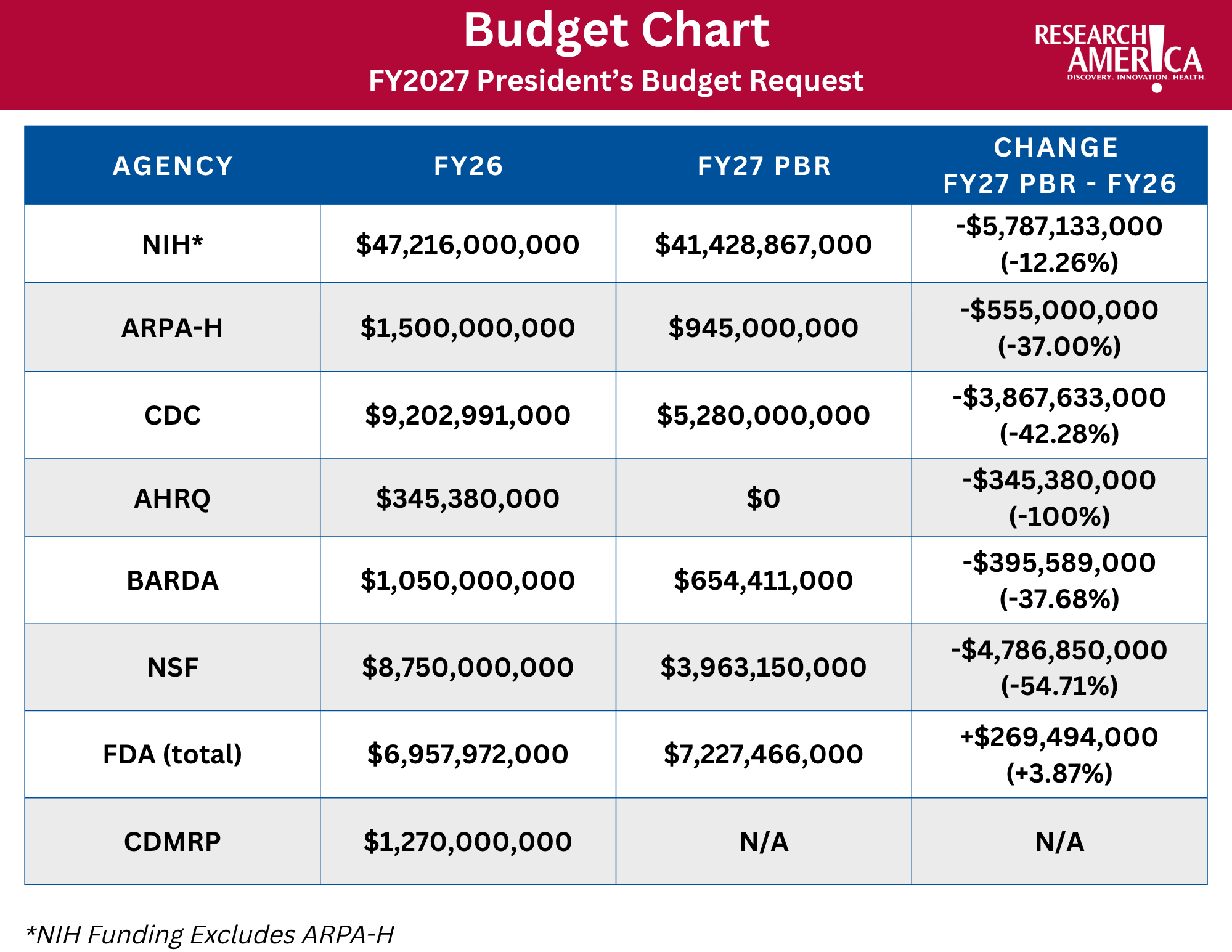
-
- Chop $5.7 billion from the NIH, exclusive of ARPA-H, a cut of more than 12%.
- Cut the ARPA-H budget by $555 million or 37%.
- Slash NSF’s budget by more than half, a cut of approximately $4.8 billion.
- Cut CDC funding by nearly $3.9 billion (over 42%).
- Eliminate AHRQ.
- Slash BARDA by roughly $396 million (nearly 38%).
- Slightly increase FDA funding by $269 million or 3.9%.
Despite the modest increase for the FDA (which reflects a reduction in budget authority and an increase in industry user fees), the proposal is deeply concerning. (Read more via our media coverage in Bloomberg Government and MedPage Today.) The budget proposal includes unwelcome policy changes, such as establishing 100% forward funding in FY27.
As a reminder, without additional appropriations, 100% forward funding would require NIH to pay for multiple years of grants up front, dramatically reducing the number of new awards each year and limiting opportunities for researchers.
For more health-related budget details, see the HHS FY27 Budget in Brief and agency Congressional Justifications. (The NIH Congressional Justification has not yet been released.)
NIH Indirect Costs Update: The Trump Administration has dropped its legal challenge (subscription required) to cap NIH indirect cost payments, leaving court rulings blocking the policy in place. However, the administration is continuing to pursue changes through the congressional appropriations process. For updates, see our Administrative Actions Tracker.
Tracking NIH Grantmaking: This week, Research!America alliance member AAMC has updated its NIH funding dashboard, which tracks trends in extramural funding. Recent data show the pace of NIH spending has picked up in recent weeks. As you review the data, keep in mind that forward funding may appear higher in FY26 compared to FY25, partly because FY25 figures reflect a point in time and much of that funding occurred later in the fiscal year.
NSF Update: In addition to cutting the NSF’s budget by more than half, the president’s FY27 budget request proposes eliminating the agency’s Social, Behavioral, and Economic Sciences (SBE) directorate, a major research directorate with strong statutory grounding and long-standing congressional support. Reports indicate NSF leadership has already begun taking steps to vacate the directorate, contrary to FY26 appropriations. See our new explainer on the significance of SBE funding.
Cuts Across the Science Spectrum: The Association of American Universities recently published an article showing that China has officially surpassed the U.S. in R&D spending. This should serve as a wakeup call to policymakers: Now is not the time to pull back on federal investments in science, technology, and medical innovation. To provide a more complete picture, here is an expanded version of our budget chart that captures science and technology agencies beyond those highlighted above. We urge Congress to bolster science, technology, and biomedical research, not stymie it.
Annual Meeting of Members: Join us on April 23, from 1-2:15 p.m. ET, for Research!America’s Annual Meeting of Members, during which new board members will be introduced. National Cancer Institute Director Dr. Anthony Letai will give remarks, and I look forward to my chat with Research!America Board Vice Chair and APHA Executive Director Dr. Georges C. Benjamin. There will also be a patient spotlight you won’t want to miss. If your organization is a Research!America member, check your inbox for registration information or reach out to Jasmine George.
Mark Your Calendars: Upcoming Alliance Discussions
- We are thrilled to host Amy Comstock Rick, Associate Director for Rare Disease Strategy at the Center for Drug Evaluation and Research (CDER) at FDA and Director of Strategic Coalitions for the Rare Disease Innovation Hub, on Thursday, April 30, at noon ET on Zoom. Amy, who is an emeritus board member of Research!America, will discuss FDA’s work to advance treatments for people living with rare diseases. Hear directly from FDA leadership. Register here.
- Join us for a special member-only Zoom discussion on Thursday, April 23, from 11:30 a.m. to 12:15 p.m. ET featuring Megan Mott and Stephen Steigleder, Professional Staff Members for the Minority on the Senate and House Labor-HHS Subcommittees. They will provide an update on the FY27 appropriations process, with a focus on NIH. Registration is limited to individuals from Research!America member organizations. Watch for an invite or email Jacqueline Lagoy. Interested in joining the alliance? Contact Donald Cook.
Support Our Advocacy Work: Your support is critical for our advocacy efforts. Research!America is working every day to ensure our nation’s discovery, development, and innovation ecosystem not only survives, but thrives. Working together, we can make medical and public health progress a higher national priority. Donate now.