


HHS Budget an Improvement, but It Won’t Drive Medical Progress

Arlington, Va. – Research!America, the largest multi-sector alliance advancing scientific research to achieve better health and well-being for all, thanks House Appropriations Committee Chair Tom Cole (R-OK), Ranking Member Rosa DeLauro (D-CT), and Subcommittee Chair Robert Aderholt (R-AL) for including a $100 million increase for the National Institutes of Health (NIH) in the FY27 LHHS bill.
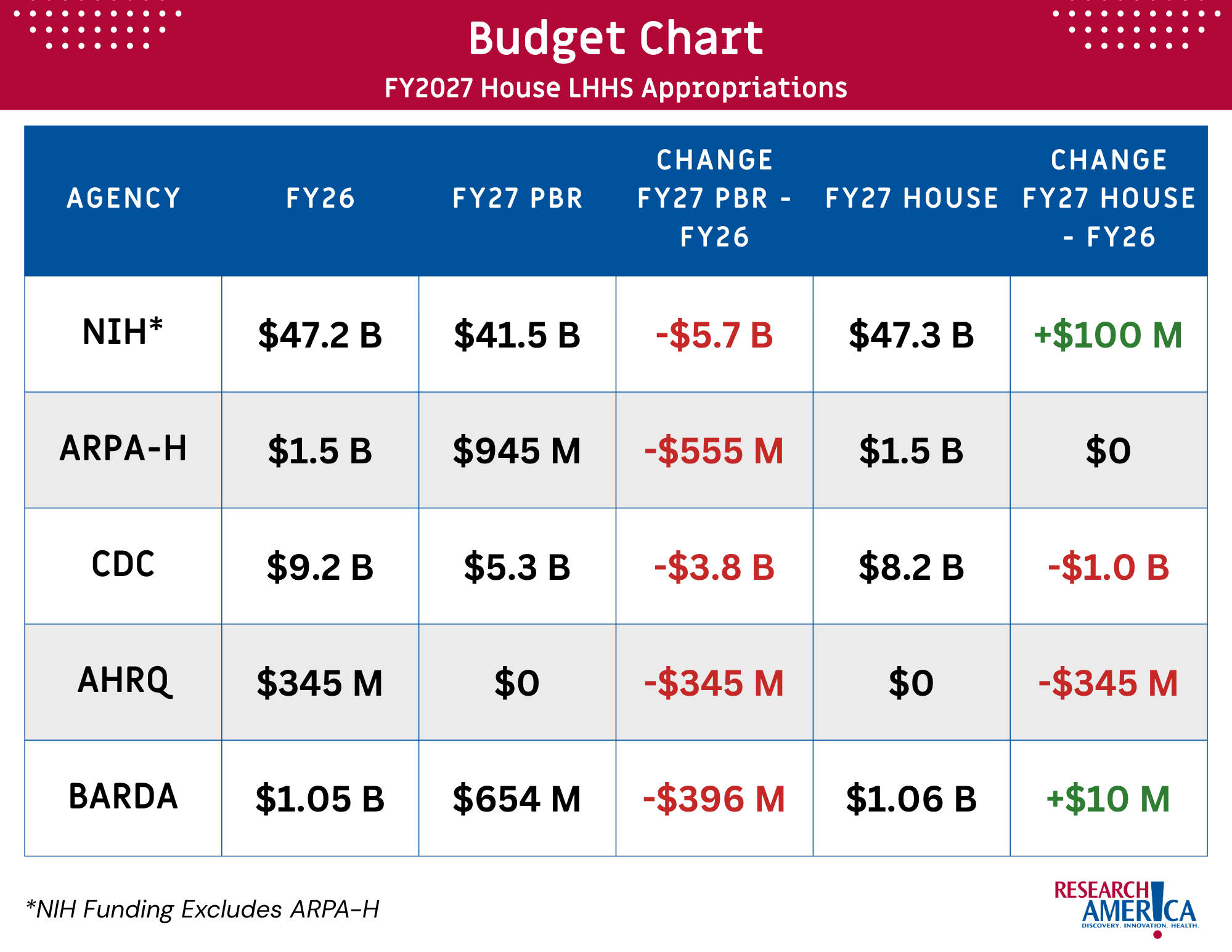
This funding bill improves upon the president’s budget proposal in other meaningful ways, and we recognize the significance of these incremental improvements. We also appreciate the Committee’s approval of guardrails around the use of multi-year funding to help prevent a dramatic drop in the number of grants awarded in FY27.
But for American patients and the economy, incremental improvements won’t drive the progress we need or even ward off failure. To stop heartbreaking diseases like ALS, cancer, and Alzheimer’s, we must make more than tentative progress. Our investments in medical and health research should run circles around our competitors, not have our nation hobbling toward the finish line as we are now. Research!America and our members reassert the need for at least $51.3 billion in funding for NIH in FY27.
Going bold isn’t optional; it’s the only path forward to the health, prosperity, and security that Americans deserve.
In that same vein, we are deeply concerned about the $1 billion budget cut to the CDC, our nation’s front-line defense against domestic disease outbreaks and deadly global health threats that endanger American lives.
We also strongly oppose the elimination of funding for the Agency for Healthcare Research and Quality (AHRQ) and the Patient-Centered Outcomes Research Institute (PCORI). AHRQ and PCORI play complementary roles in the herculean task of ensuring medical progress translates into the best care possible for patients. Our nation has historically underfunded this priority, and it is time to reverse course by building out the evidence needed to address rural health disparities, medical errors, health care-associated infections, and needless red tape in the health care system.
The committee’s spending bill is currently under the shadow of a newly proposed Office of Management and Budget rule that would significantly change federal grantmaking. If finalized, the rule would, for example, allow termination of grants for “convenience.” It would also establish political appointees as the final decision makers on every grant and cooperative agreement. This and any future administration could more easily subvert Congressional intent and fund grants based on political or ideological goals, not scientific merit. That’s not a strategy for faster medical progress; it’s a recipe for disaster.
Contact Glenn O’Neal, Senior Director of Communications, at 571-482-2737 or [email protected] with press inquiries.
###