


Lame Duck Begins
This week, newly elected members of Congress arrived in Washington, D.C., for orientation ahead of the 120th Congress. Congressional Republicans also held leadership elections, with Senate Republicans reelecting Sen. John Thune (R-SD) as their leader and House Republicans electing Rep. Jim Jordan (R-OH) as their leader. House Democrats are expected to hold their leadership elections next week, while Senate Democrats are scheduled to vote in early December.
FY27 Appropriations Remain Uncertain: The Continuing Resolution for government funding, which includes a block on the Office of Management and Budget’s (OMB) proposed rule governing federal grants, ends Dec. 11. This week, House and Senate appropriations leaders met to discuss a path forward on FY27 funding, and Senate Appropriations Chair Susan Collins (R-ME) began releasing Republican FY27 appropriations bills, including the Agriculture-FDA appropriations bill and accompanying explanatory statement.
- Details on Senate FDA Appropriations bill: The bill provides $7.27 billion in total FDA funding, a $307.4 million (4.4%) increase over FY2026. Of that amount, $3.52 billion would come from congressional appropriations, $100 million (2.9%) above FY2026, $156 million above the House proposal, and $216 million above the president’s FY2027 budget request. The remaining approximately $3.75 billion would come from industry user fees.
At the same time, Senate Appropriations Vice Chair Patty Murray (D-WA) has raised the possibility of extending government funding at current levels until January of next year, when Democrats will hold majorities in both the House and Senate.
The situation clearly remains fluid. What remains rock solid is the need to prevent a government shutdown, ensure that OMB is prevented from implementing its proposed rule, and that medical research is robustly funded. Use this editable email, which will be sent directly to your senators and House representative, to make the case!
Nominations: The Senate HELP Committee is scheduled to hold an executive session on Nov. 18 to potentially vote on the nominations of Heidi Overton, M.D., to serve as Commissioner of the Food and Drug Administration (FDA) and James O’Neill to serve as Director of the National Science Foundation (NSF). While the committee held a hearing on the Overton nomination, it has not done the same for O’Neill’s. We believe the role of NSF director bears too strongly on American jobs, security, and competitiveness to hold a vote before the public learns more about O’Neill’s vision and objectives for the agency. See our statement calling for a hearing.
Russ’s Corner
Last week, the landscape of Congress changed dramatically for 2027, and the White House has a new chief of staff. What do these changes mean for medical research? No one can say for sure, but I can make an educated guess.
With the Mississippi Senate race called last night, the Democrats now have 55 seats out of 100 and may end up with 56 seats. That party also has a sizable majority in the House. But the White House is still Republican and Democrats do not have a veto-proof majority in Congress. Historically, a divided government does not produce much major legislation. However, there are always must-pass bills, such as appropriations. That gives us some hope that the damage caused by the OMB can begin to be reversed.
What we have on our side is the fact that medical research has been, and continues to be, a bipartisan issue. Medical research has champions on both sides of the aisle for compelling reasons: research benefits patients, research helps us compete against China, just to name two. Research champion Sen. Collins lost her seat, but we still have incoming Chair Murray as well as Reps. Cole (R-OK) and DeLauro (D-CT), among others. We now have the opportunity to cultivate new champions.
The stage may be set for significant gridlock on some issues over the next two years, but I do expect that through advocacy, Congress on a bipartisan basis will begin rolling back the deterioration of research in the U.S. and put us on the path of actually building something better.
Russ

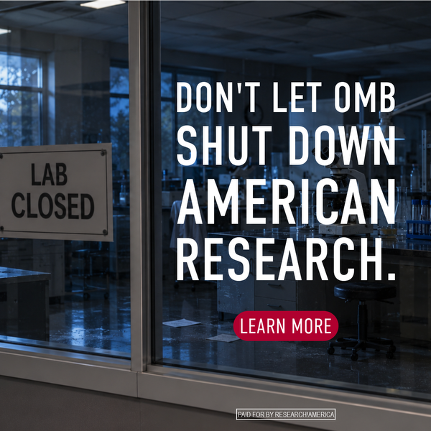 Drumbeat: This week, a coalition of 37 scientific societies led by Research!America launched an updated ad campaign in the D.C. market to urge members of Congress to oppose OMB’s proposed rule. Research!America is also among the 32 organizations that have joined United for Cures in publishing print ads in The Washington Post, The New York Times, The Wall Street Journal, and The Hill. To add to the chorus of voices against the OMB rule, Russ wrote this letterpublished earlier this week in The New York Times.
Veterans Day Research Stories: In honor of Veterans Day yesterday, member NAVREF highlighted the importance of research in the veterans community. One resource, Voice of the Veteran, features first-hand accounts of service members who have participated in and benefited from clinical trials at the VA. Consider using these accounts, which bring research down to earth, in your advocacy.
Science Microgrants and Awards, Deadline Approaching: The application deadline is fast approaching for our Civic Science Microgrants and Awards Program. Send in your applications by Nov. 20.
Support Our Advocacy Work: Your support is critical to our advocacy efforts. Research!America is working every day to ensure our nation’s discovery, development, and innovation ecosystem not only survives, but thrives. Help us protect and bolster research that saves lives. Donate now.