

Many Sectors, One Message
If you have not had an opportunity to dig into the data the Association of American Medical Colleges (AAMC) includes in its NIH funding tracker, the most recent update reveals several important trends. For example, while it appeared that NIH was beginning to make up for previous funding delays, we are now seeing practically the same uncertain rush to the finish that we saw this time last year. The AAMC resource also tracks the number of NIH grants awarded; as anticipated, an increased number of multi-year funded awards is eroding the total number of grants.
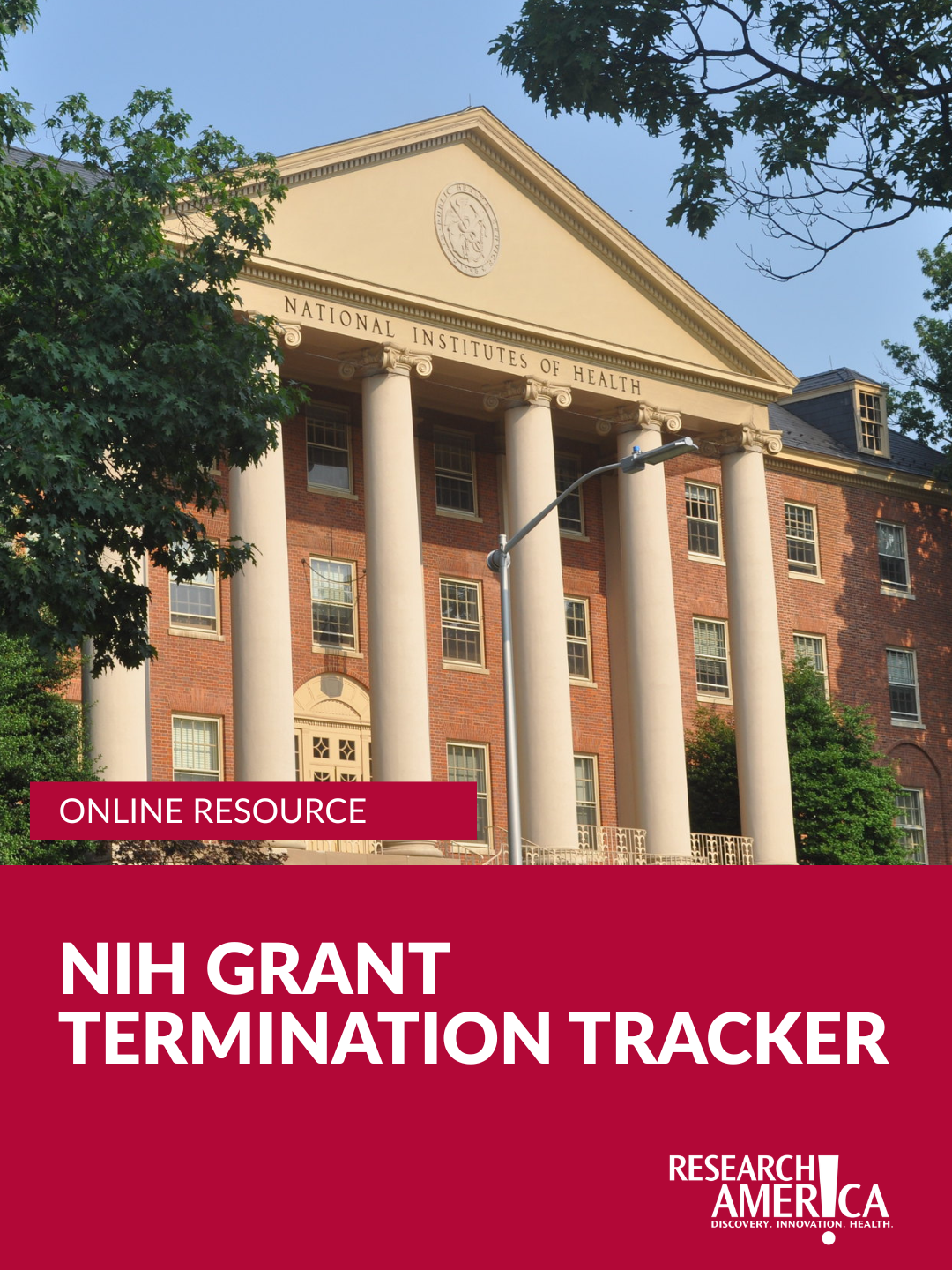 Another piece of the puzzle: Research!America continues to provide detailed information on NIH grant terminations. As you can see in our NIH grant termination tracker, terminations slowed following a court ruling last year, but they haven’t stopped entirely. In just the five days between July 16 and July 21, at least 19 NIH grants were cut.
As you’re reaching out to congressional offices in opposition to OMB’s proposed rule, please be sure to note your concern about the slow spend and grant terminations at NIH. As we saw last year, when members of Congress reach out to federal agencies, the tide can turn.
Speaking of which, and with apologies for more concerning news, research supported by the Agency for Healthcare Research and Quality (AHRQ) is facing another major blow. AcademyHealth’s Research Interrupted tracker has confirmed 104 canceled grants across 28 states, representing $131.3 million in committed funding that is now lost. AcademyHealth has told partners that its investigation is ongoing and that the actual total may be between 150 and 190 grants across 29 states.
Research!America contacted senators this week urging them to sign a letter led by Sen. Richard Blumenthal (D-CT) that calls on HHS to reverse the AHRQ grant cancellations immediately, and to meet its statutory obligation to spend AHRQ’s full FY26 appropriation by the end of the fiscal year. Sen. Blumenthal is seeking bipartisan support for the letter. You can help by using our editable action alert to reach your senators and ask them to sign on.
On the Hill: Before leaving Washington last week, the House passed a continuing resolution (CR), a short-term funding bill that would fund the government through Dec. 4. Senate Appropriations Committee Chair Susan Collins (R-ME) and Vice Chair Patty Murray (D-WA) are reportedly negotiating a bipartisan CR that could be made public as early as tomorrow. We have been pushing hard for an “anomaly” to be included in the CR that would stop the proposed OMB rule from being finalized during the period the CR is in effect. This would give the public more time – needed and deserved – to weigh in on this proposal.
In the News: NPR’s All Things Considered has covered the administration’s cuts to federal advisory boards and what that means for U.S. research and technology. Research!America President and CEO Russ Paulsen was quoted about the importance of these expert boards. Russ highlighted that, “we need to have a diversity of opinions to get the best science done.” Listen to the story online here.
Russ’s Corner
One of the most encouraging developments since the close of the public comment period on OMB’s proposed rule regarding federal grantmaking: the research community is far from alone in raising concerns.
– County governments have warned about the potential impact on their ability to deliver federally supported services.
– Architects and civil engineers have raised concerns about uncertainty for affordable housing and other critical infrastructure projects.
– Transportation associations are concerned about the impact on project costs and investments in roads, highways, bridges, and aviation systems.
– Biotechnology companies have cautioned that the proposal could slow innovation and make it harder to bring new discoveries to patients.
While some of the details may differ, the underlying message is remarkably consistent: this proposed rule would make the federal grantmaking process more bureaucratic, more chaotic, and less productive.
That’s something our country cannot afford.
I encourage you to read the comments these organizations have submitted (linked above). Their concerns reinforce that this is not simply a debate about research. It is a broader conversation about whether the federal government should adopt policies that create unnecessary barriers, making it harder for virtually every sector of our economy to solve problems, strengthen communities, and improve lives. The more we understand how this proposal affects other sectors, the stronger our collective case becomes.
Finally, if you have connections with organizations or industries that would also be affected by this proposed rule, please let us know by emailing Trent Carlson. We are working collaboratively with partners to coordinate with other stakeholders. Together, our voices carry further than any one sector can alone.
Russ

CDC, Health Emergency Nominees Advance: The Senate HELP Committee voted today to advance the nominations of Dr. Erica Schwartz to be director of the CDC and Sean Kaufman, M.P.H., to lead the Administration for Strategic Preparedness and Response. Both nominations head to the Senate floor for a final vote.
Gavi Funding: After HHS halted $600 million in appropriated funding to Gavi, the Vaccine Alliance, earlier this year, the State Department has reversed course. Senate Appropriations Chair Susan Collins (R-ME), following bipartisan outreach, announced that the State Department will contribute the $600 million appropriated in FY25 and FY26 to replenish U.S. funding. Gavi, a past Research!America Rapid Translation Award recipient, has helped vaccinate more than one billion children worldwide.
Support Our Advocacy Work: Your support is critical to our advocacy efforts. Research!America is working every day to ensure our nation’s discovery, development, and innovation ecosystem not only survives, but thrives. Working together, we can make medical research and public health, as well as overall science and technology progress, a higher national priority. Donate now.