

Some Rules Need to be Broken
Last week, the Office of Management and Budget (OMB) released a proposed rule that would significantly change how federal grants and cooperative agreements are awarded, managed, and terminated across the federal government. The rule would revise the “Uniform Guidance,” the government-wide framework governing federal financial assistance, giving the force of law to what are currently recommendations related to federal grantmaking.
If finalized, the rule would, for example, allow termination of grants for policy reasons, not just compliance or performance failures; establish political appointees as the final decisionmaker on every grant and cooperative agreement; put in place a host of new administrative requirements for grantmaking agencies and recipients; and codify limits on racial, ethnic, and gender-related research. Public comments are due July 13, and OMB intends for the rule to take effect Oct. 1.
See Russ’s Corner for details on our advocacy efforts on this issue.
On the Hill: The House Labor-HHS Appropriations Subcommittee released its FY27 bill text today ahead of tomorrow’s expected markup (watch here). The proposal rejects many of the deep cuts included in the president’s budget request and provides a ~$100 million increase for the NIH. ARPA-H would be flat-funded. The bill includes a substantial reduction for CDC and would eliminate funding for AHRQ and the Patient Centered Research Institute (PCORI). Additional budget details are expected as more complete bill materials become available. Our preliminary budget chart is available here.
We thank House Appropriations Committee Chairman, Tom Cole (R-OK) and Committee and Sub-committee Ranking Member Rosa DeLauro (D-CT), as well as Subcommittee Chairman Robert Aderholt (R-AL), for providing increased funding for NIH. It signals crucial continued bipartisan support for life-saving medical research. But to meet the health and competitive challenges our nation faces, we need to work faster to overcome threats to American health, wherever they arise. We are deeply concerned by the proposed cuts to CDC, our first line of defense against global health threats, and the elimination of two agencies, AHRQ and PCORI, which are laser-focused on responding to the real-world problems Americans face when they interact with the health care system.
As the House begins marking up the FY27 Labor-HHS appropriations bill, now is an important time to engage. Use our editable email to encourage your members of Congress to champion robust and reliable research funding for FY27. Your individual influence can make the difference in funding outcomes!
In other Hill news, Reps. Sharice Davids (D-KS) and Brian Fitzpatrick (R-PA), joined by 37 bipartisan colleagues, sent a letter to HHS Secretary Robert F. Kennedy Jr. expressing concern that NIH staffing shortages are slowing the distribution of congressionally appropriated research funding. We thank Reps. Davids, Fitzpatrick, and their colleagues for seeking answers on NIH staffing and grant award delays and for reinforcing the importance of ensuring NIH can efficiently deliver funding approved by Congress.
Russ’s Corner
There are times when we need to stop what we are doing, get everyone together to coordinate plans, and then act. This is one of those times. We are facing what one calm person has called “a 5-alarm fire” that is in the form of a newly proposed, 400-page rule that would harm our nation’s research capabilities.
Under this proposal, research could be stopped at any time, for any reason, by accountants and bureaucrats. Multi-year projects could easily be stopped midway when the political winds shift. Imagine having a family member enrolled in a clinical trial that was stopped midway because a political appointee changed jobs. That is no way to treat a patient and no way to cure disease.
As a multi-sector alliance, one of our strengths is the ability to bring a wide array of stakeholders together under one large tent. And that’s just what we’re doing: We’re gathering stakeholders with various perspectives and from different disciplines to learn and listen together, and develop a strategy to stop this rule from undercutting scientific and medical progress. We hosted two important conversations this week, with more to come.
This is just the beginning of our efforts, both individually and collectively. We know we must submit comments on the rule, and we will soon have a guide available to our members on how best to do that. We must engage with members of Congress and the administration, and we will soon offer tips on how best to do that, based on what we are learning from our early conversations this week. And, we must engage with the voting public, as they have the most to lose if this rule is implemented. More to come on that as well.
Together as a community we must ensure that medical and scientific research continues to power American innovation and diagnostics, cures, and treatments for Americans.
Russ

Upcoming Member-only Meeting: Join us on Wednesday, June 10, from noon to 1 p.m. ET, for a Washington update. Between the appropriations process and the OMB proposed rule, we’ll have plenty to discuss!
If you are affiliated with a Research!America member organization, please email Jacqueline Lagoy for the Zoom registration link.
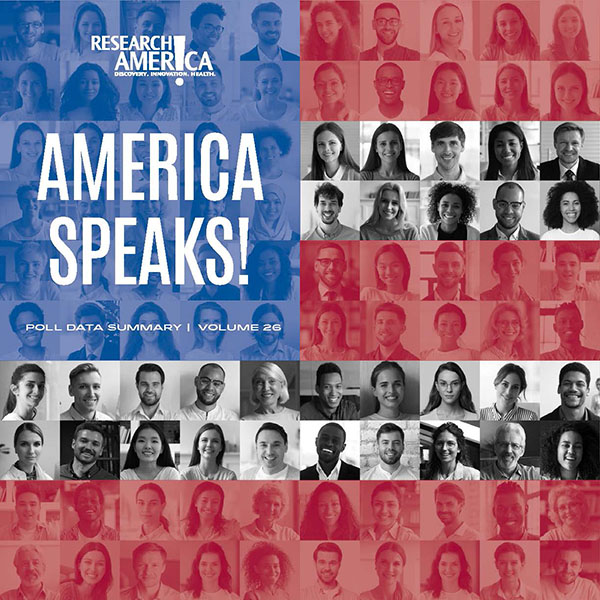 Hot Off the Press: Research!America just released our 26th annual poll data summary, America Speaks! The publication provides a look at the findings of recent research and public health-focused surveys. A special thanks to the American Medical Association for its generous funding of this resource. This summary is timely for advocacy: one of the many compelling results included in this new resource: 92% of Americans across the political spectrum say the federal government should support basic scientific research that advances the frontiers of knowledge even if there are no immediate benefits.
Looking at a Storied Career: Take a few moments for this podcast by Issues in Science and Technology. Our own Mary Woolley spoke with Josh Trapani about the transitions she has seen in science and the role of scientists over her career. She also shares how researchers can engage with policymakers and the community.
New NIH Alumni Network: The Foundation for the National Institutes of Health (FNIH) recently launched a new NIH Alumni Network to provide former NIH staff with opportunities for engagement, professional development, and supporting the next generation of scientists. More information, including how to join, can be found at FNIH.org/nih-alumni-network.
Support Our Advocacy Work: Your support is critical for our advocacy efforts. Research!America is working every day to ensure our nation’s discovery, development, and innovation ecosystem not only survives, but thrives. Working together, we can make medical and public health, as well as overall science and technology progress, a higher national priority. Donate now.