


As AI Becomes Mainstream, Public Opinion Shifts
Hardly a day goes by without a new headline about the rapidly evolving technology of artificial intelligence (AI). Even the number of chatbots and generative AI that are used by the public is rising, with nearly a quarter of the ads during Superbowl LX in 2026 advertising AI to the viewers or were commercials made by AI. But despite this push, public opinion is leaning toward viewing AI as a risk rather than a benefit.
For more than 30 years, Research!America has commissioned annual public opinion surveys to better understand Americans’ views on medical, health, and scientific research and other pressing issues related to public health, research, and innovation. Commissioned and released just ahead of the midterm election cycle this year, our 2026 national survey provides insights into the most important health and research-relevant issues for Americans, as well as the visibility of science in our society today.
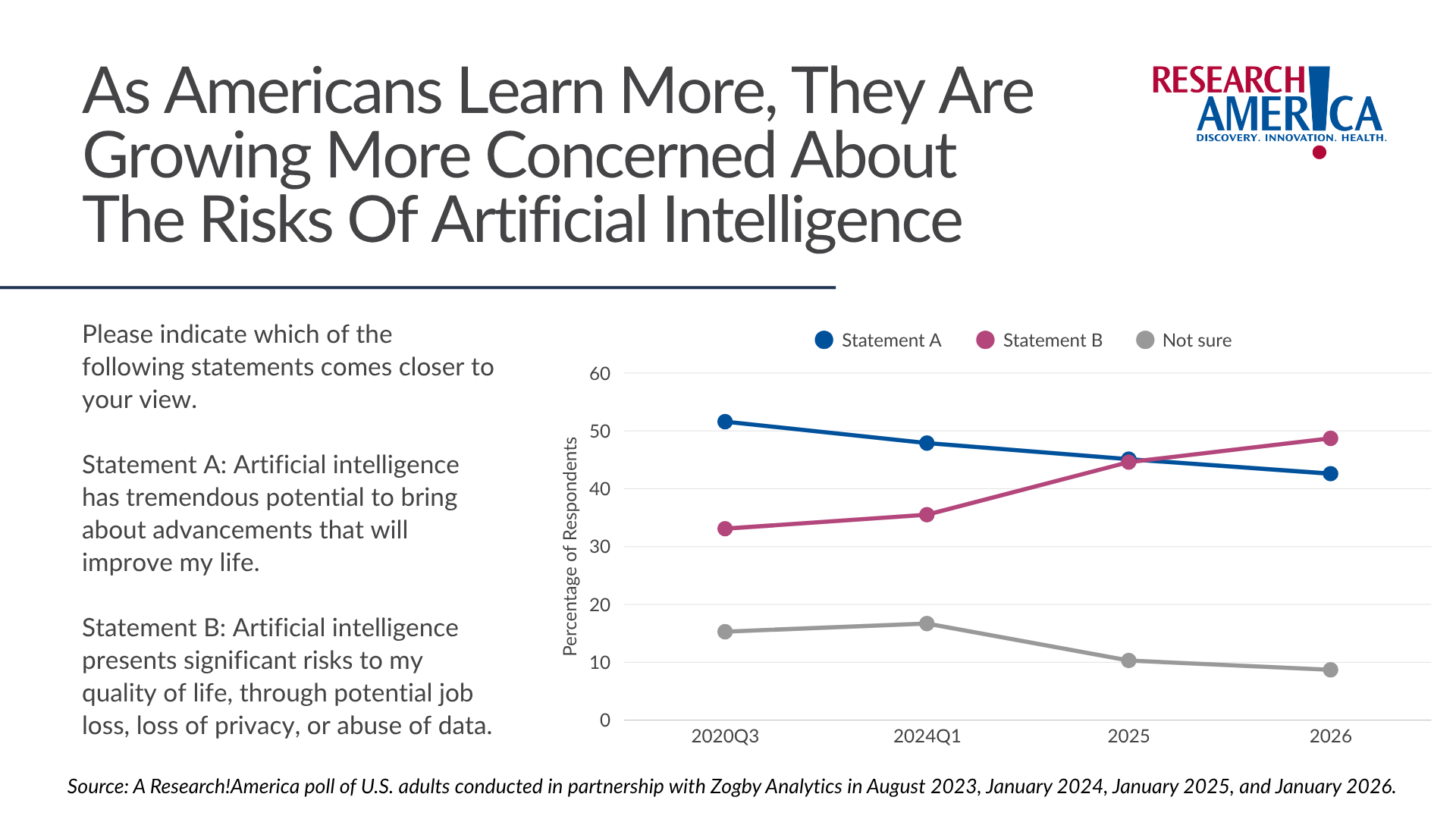
One survey question we’ve focused on recently asks respondents to indicate which of the following statements comes closer to their own view:
Statement A: Artificial intelligence has tremendous potential to bring about advancements that will improve my life.
Statement B: Artificial intelligence presents significant risks to my quality of life, through potential job loss, loss of privacy, or abuse of data.
This question was also asked in other surveys in 2024 and 2020. Through these years of responses, we were able to track some trends among the general population of American people, as well as by age group, gender, and education level over time.
From 2020 to 2026 our surveys show that overall, as the public learns more about AI, the number of Americans who see AI as presenting risks are increasing, while the number of respondents saying it is a benefit is trending downward.
One interesting thing to note when looking at age breakdown is that those between 18 and 24 years old are more likely to say AI is a risk and much less likely to say it is a benefit. The reasoning may correspond with a few other survey results: those ages 18-24 were more likely to pick climate change as the single most important health issue facing the nation, and that fewer jobs were the reason that today’s children in America will grow up worse off. With AI increasingly replacing jobs and using energy and water for new data centers to accommodate this technology, the correlation makes sense.
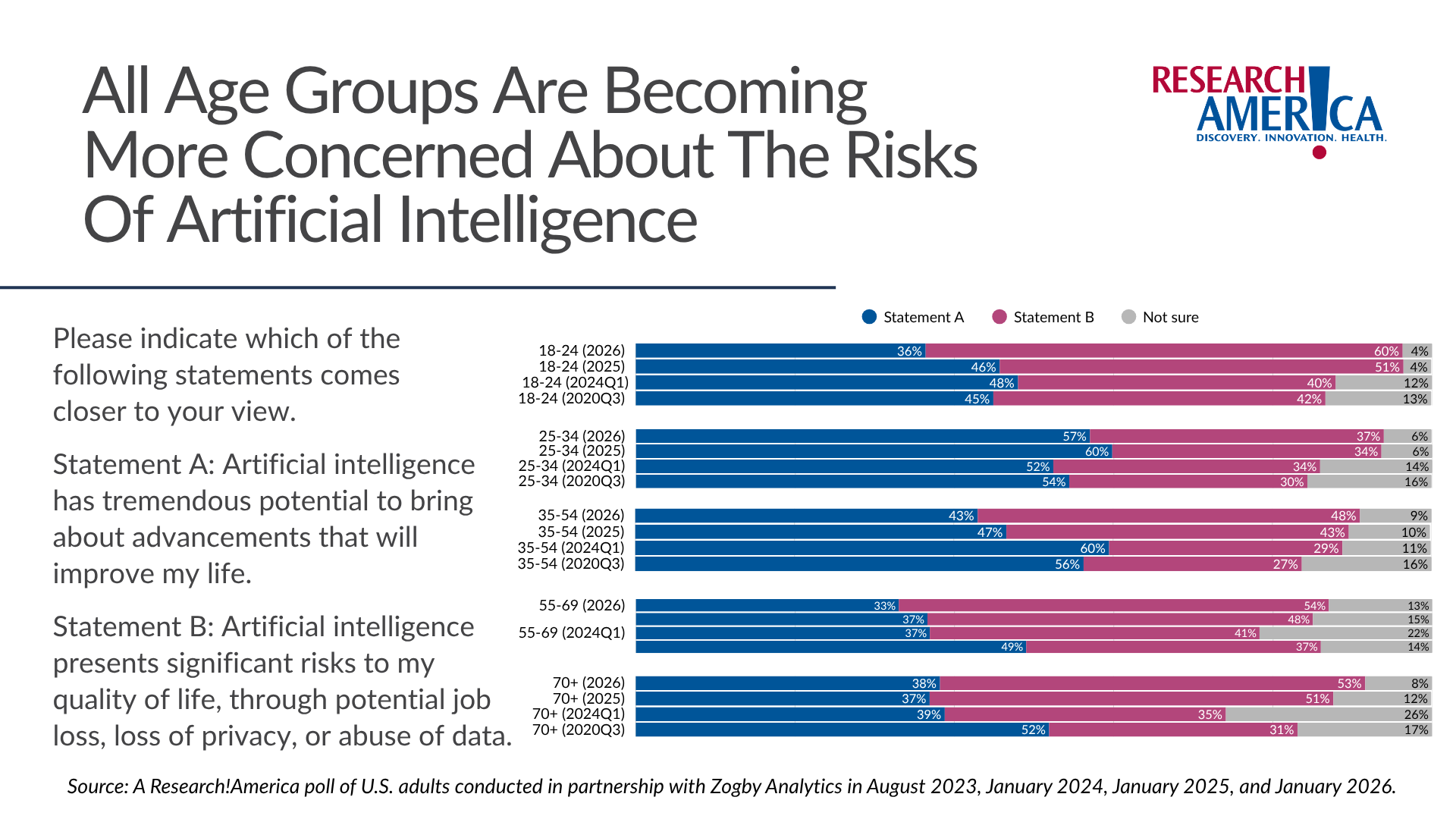
Even though they have selected statement B more over time, respondents with college degrees are more likely to say that AI is a benefit to them than those without college degrees. However, as a whole, looking at the data by gender and education level also showed that in every single category – whether male, female, college graduate or not – the number of Americans choosing statement B, that AI is a risk, is growing, and those selecting statement A, that AI is a benefit, is shrinking. As people are becoming more informed, they are deciding that AI is more of a risk than a benefit.
Explore additional insights into Americans’ views on health research and medical progress, like these, with our latest public opinion survey.