


Can You Name A Living Scientist?
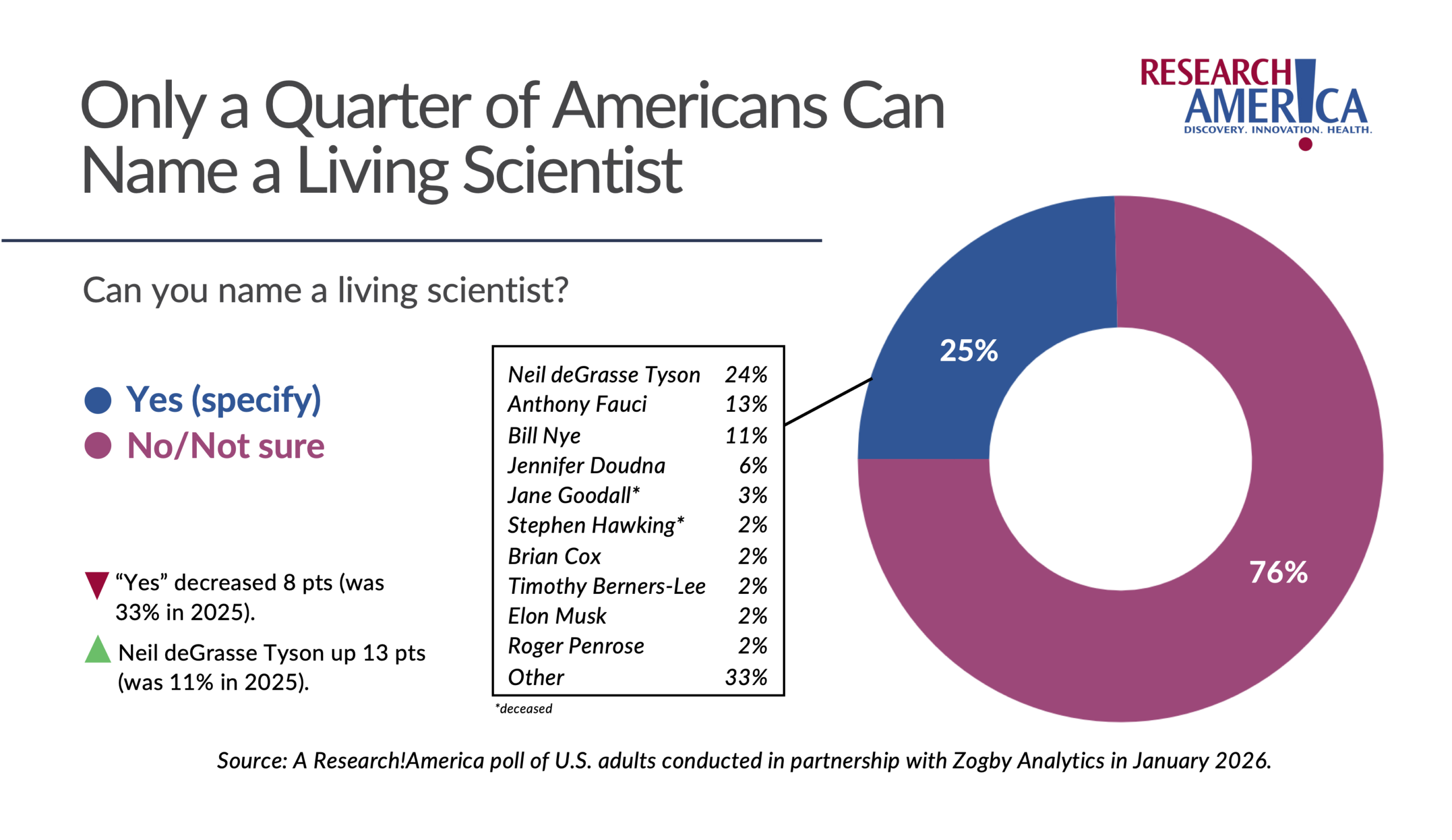 “Can you name a living scientist?”
That may seem like an easy question, but over the past decade that we’ve been asking that question of the American public, its responses have shed light on the lack of visibility that scientists experience in our society.
For more than 30 years, Research!America has commissioned annual public opinion surveys to better understand Americans’ views on medical, health, and scientific research and other pressing issues related to public health, research, and innovation. Included as part of our 2026 national survey, the oft-asked question, “Can you name a living scientist?”
In this year’s survey, only a quarter of Americans say they can name a living scientist, down from one-third last year. Respondents who answer “Yes,” are then asked to give a name. Below are some of the most frequently named living scientists, along with brief descriptions of their contributions to scientific research.
Here are brief descriptions of the scientists who were most often mentioned by the survey respondents:
Neil deGrasse Tyson was named by 24% of respondents. Tyson, an American astrophysicist, author, and science communicator, has a B.A. in physics and a Ph.D. in astrophysics. Tyson was appointed multiple times to serve on commissions for the U.S. government and NASA to research and promote a thriving future for space exploration and national security. He has published research and novels and continues to communicate the importance of science to the public through documentaries, TV programs, and podcasts. He has spoken about science and research for his entire career and continues to be dedicated to public engagement today.
Anthony Fauci was named by 13% of respondents. Fauci, an American physician-scientist and immunologist, has a B.A. in classics and an M.D., focusing mainly on infectious diseases and the immune system in medical school. Fauci was the director of the National Institute of Infectious Diseases at the NIH for more than 35 years, notably advising several presidents on combating, researching, and treating global HIV/AIDS since the early beginnings of the pandemic. Fauci played a key role in both the Trump and Biden administrations in addressing the COVID-19 pandemic. He also received numerous honorary degrees and awards for his contributions to science, including infectious disease preparedness and treatment development.
Bill Nye was named by 11% of respondents. Nye, an American science communicator best known for writing, producing, and hosting the PBS children’s science show, “Bill Nye the Science Guy,”has a B.S. in mechanical engineering. Nye worked as an engineer for more than 20 years before venturing into educational entertainment. Nye joined The Planetary Society, the world’s largest nonprofit space interest group, as a Charter Member in 1980 and is now the CEO, helping to advance space science. He has published many books, hosted many lectures, and been featured on many TV series, popular media, and podcasts (including his own).
Jennifer Doudna was named by 6% of respondents. Doudna, a Nobel laureate and American biochemist, has a B.A. in biochemistry and a Ph.D. in biological chemistry and molecular pharmacology.Doudna has made fundamental contributions in biochemistry, including the development of a method for genome editing, for which she won the 2020 Nobel Prize in Chemistry along with Emmanuelle Charpentier. This method holds massive potential for treating genetic diseases, and Doudna’s lab’s work with CRISPR-Cas9 has been called one of the most significant discoveries in the history of biology. Doudna is currently a professor of biochemistry, biophysics, and structural biology, and she was inducted into the National Inventors Hall of Fame in 2023.
These are just a few insights from our latest national survey. Explore more interesting and timely findings on our website.