

Putting Pen to Paper
This week, Hal Duncan, the nominee for deputy White House budget director (the #2 position at OMB), testified before both the Senate Budget Committee and the Senate Homeland Security and Governmental Affairs Committee.
During the Senate Budget Committee hearing, Sen. Patty Murray (D-WA) questioned Duncan about the “very concerning proposed [OMB] rule” and asked what safeguards would prevent the administration from awarding or denying grant funding based on political ideology. The hearing also touched on OMB’s use of fiscal tools, including “pocket rescissions,” which was used in August of last year to cancel approximately $4 billion in foreign aid funding. When asked about the practice, Duncan declined to rule out its future use.
Speaking of funding… The full House Appropriations Committee is scheduled to consider the Defense bill, which allocates funds for Congressionally Directed Medical Research Programs (CDMRP), on June 24 (watch here). Additional details and accompanying report language are expected to be released next week as well. As the 12th and final FY27 appropriations bill to move through the House Appropriations Committee, its markup will complete committee action on all House spending bills.
Meanwhile, the Senate has yet to begin marking up any of its FY27 appropriations bills. Negotiations over topline spending levels and disagreements over amendments have stalled the process, raising concerns that the lack of progress could increase the risk of a government shutdown this fall.
Russ’s Corner
Every year, we focus great attention on the appropriations process. We typically advocate for an increase in funding for the programs we care about, and for the past many years, often we look to the appropriations bills and their accompanying committee reports for policy-oriented outcomes.
We need to keep doing that.
We also need to keep our eyes on what happens after the appropriations process concludes for the year. Are the departments and agencies making the investments of our tax dollars in ways that will move the best science forward?
Which brings us to the proposed rule from OMB. We learned this week that there will not be an extension of the July 13 deadline to submit comments, despite our request, which we submitted along with 322 other organizations. Similar requests from many others have been denied as well.
So now, it’s time to put pen to paper and state, factually and strongly, why this rule needs to be changed. Think about what consequences would be harmful to your part of the scientific enterprise, which OMB may not have considered when it drafted the proposed rule. In what ways would the proposed rule fail to advance (or perhaps undermine) the stated goals? Reminder, these goals are to: (1) improve transparency, accountability, and oversight in the use of federal taxpayer dollars; (2) change the status of the provisions in the proposed rule from “guidance,” which agencies have the discretion to adopt or ignore, to that of “regulation,” which carries the force of law; and (3) reduce the burden on those awarded federal grants or cooperative agreements.
To help with drafting your comments, Research!America has compiled these resources and hosted a public webinar featuring experts in regulatory law and in writing and reading comments on proposed rulemaking.
During that webinar, Dr. Leslie Thornton, counsel at the firm Ropes & Gray, provided a comprehensive overview of the provisions in the proposed OMB rule that would impact the research community. She advised submitting factual, substantive comments that demonstrate how OMB’s proposed rule would not fulfill its main objectives, which I listed above.
When developing comments, Dr. Yvette Seger noted that you should be sure to:
- Coordinate with your institution.
- Tell your story and provide examples of potential negative outcomes.
- Avoid using a template. Instead, share your personal perspective. To be the most effective, comments should be distinguishable from one another.
Finally, the speakers emphasized that comments should focus on the implications of the proposed rule, not on the perceived intentions.
These are just a few of the key takeaways from yesterday’s insightful webinar. The speakers fielded many important questions from the audience. I encourage you to watch the recording here. And here are the slides, which include Dr. Seger’s step-by-step instructions on how to submit comments at Regulations.gov.
We have a few weeks left, so we will be convening other meetings on this rule soon. Stay tuned. Thank you for all your efforts, partnership, and support!
Russ

Alliance Member-only Meeting: Join us for a quick off-the-record meeting on Tuesday, June 23, at 1 p.m. ET focused on advocacy to propel the appropriations process forward given concerns that we are facing another potential government shutdown. We’ll also do a bit of brainstorming on how to ensure every congressional office is aware of the consequences of OMB’s Proposed Rule for Federal Financial Assistance, and share related resources. If you are a Research!America alliance member, keep a look out in your emails for the registration link.
NIH Public Comments: NIH is seeking public input on a proposed policy that would cap the number of Research Project Grants (RPGs) that a single principal investigator can hold simultaneously. Comments are due Aug. 3. More information can be found here.
Hill Briefing on Genetically Targeted Technologies: On Tuesday, June 23, we are holding a special congressional briefing looking at the life-changing potential of Genetically Targeted Technologies (GTTs) through the lens of the patients these technologies serve. This breakfast briefing will be held from 8:30 a.m. to 10 a.m. at the Rayburn House Office Building, Room 2060. If you’ll be in the D.C. area and want to attend this in-person briefing, register here.
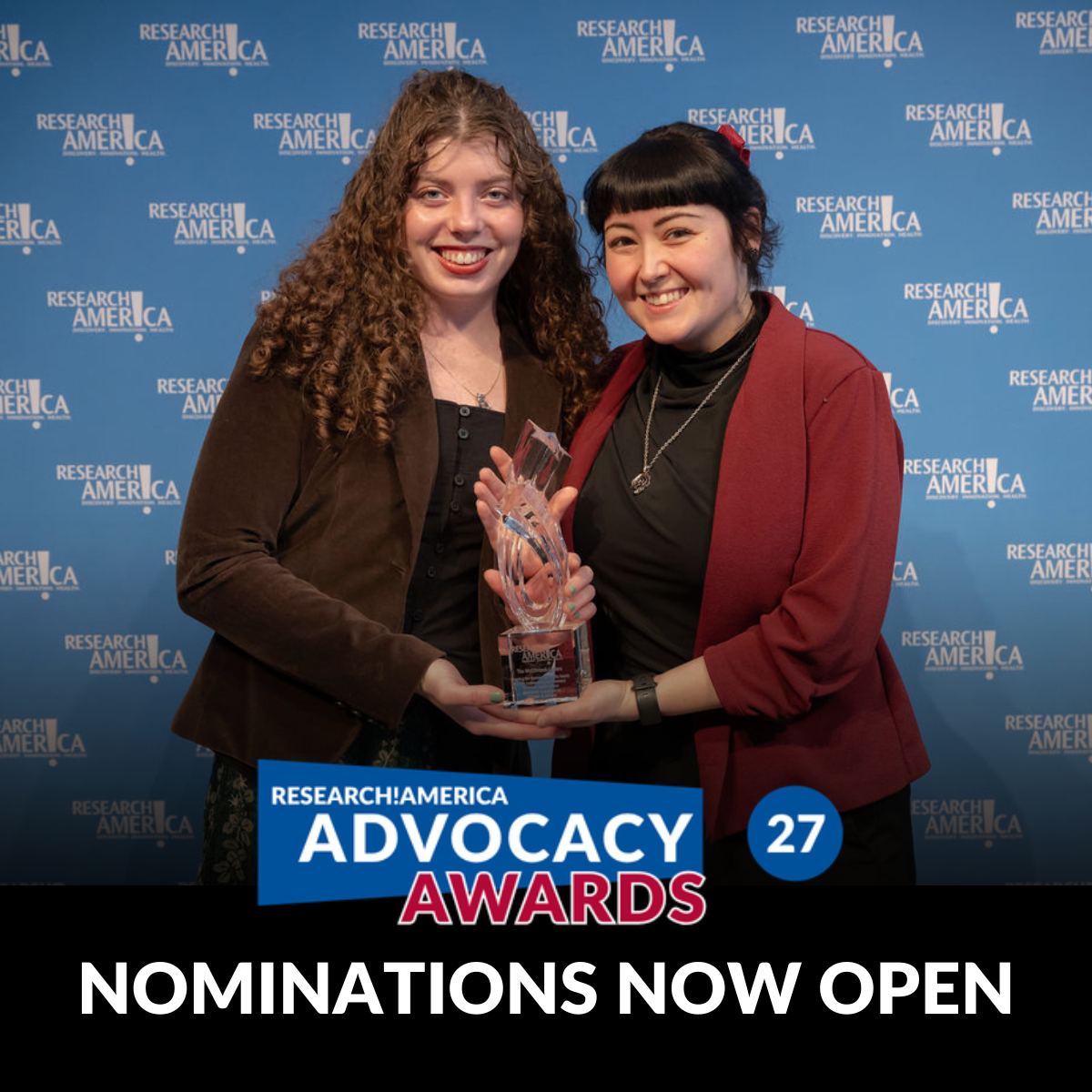 Nominate an Advocacy Champion: Now, more than ever, we need to celebrate those who are championing medical research and innovation in America. Who will be the next Research!America Advocacy Award honorees? Our Advocacy Awards recognize individuals and organizations whose commitment to advocacy for research and innovation has advanced medical, public health, and scientific progress in profoundly important ways. Take a look at the award descriptions and submit your nominations now. The deadline is Friday, July 17.
We Need You: We need you to help us improve the Research!America Weekly Letter, delivered to your inbox every Thursday. Are you getting what you want and need from this publication? What can we do to improve it? Please respond to this survey. Your input is greatly appreciated.
Early-Career Scientist Prize Opportunity: Each year, four outstanding recent Ph.D. recipients from around the globe are selected for the Science and SciLifeLab Prize for Young Scientists. Winners receive up to $30,000 and are invited to SciLifeLab in Stockholm, Sweden, in December. The application deadline is July 15. Learn more and apply here.
Support Our Advocacy Work: Your support is critical to our advocacy efforts. Research!America is working every day to ensure our nation’s discovery, development, and innovation ecosystem not only survives, but thrives. Working together, we can make medical and public health, as well as overall science and technology progress, a higher national priority. Donate now.