

Why We Do What We Do
This week, Senate appropriators were expected to begin FY27 markups, including the Agriculture, Rural Development, Food and Drug Administration, and Related Agencies (Ag/FDA) bill and the Commerce, Justice, Science, and Related Agencies (CJS) bill (which includes funding for NSF and other science agencies). Instead, markups were postponed until after the July 4 recess.
While the House has completed committee action on all 12 of its FY27 bills, the Senate has considerable ground to make up before the Sept. 30 funding deadline.
More on Appropriations: Yesterday, the full House Appropriations Committee considered the Defense bill, which allocates funds for Congressionally Directed Medical Research Programs (CDMRP). You can view the itemized CDMRP funding chart here. Keep in mind that these figures reflect only the House proposal.
OMB Director To Testify: The House Appropriations Committee’s Financial Services and General Government Subcommittee will hold an oversight hearing with Office of Management and Budget (OMB) Director Russ Vought on Tuesday, June 30, at 10 a.m. ET (watch here). The hearing comes as OMB’s proposed “Regulation for Federal Financial Assistance” continues to generate significant concerns. Check out Research!America’s new editable email you can use to urge your representatives in Congress to weigh in with the administration about the proposed rule, as well as our new step-by-step guide to writing effective comments in response to the proposed rule. Additional resources to help stakeholders prepare comment letters and engage on the proposal are available on the Research!America website.
Clinical Trials Reform: HHS this week announced “Operation TrialBlazer,” a major effort aimed at strengthening U.S. competitiveness in clinical research and the development of new therapies. The initiative, which spans multiple HHS agencies, is intended to reduce regulatory barriers and modernize clinical trial processes. As part of the effort, FDA issued a Request for Information on a proposed Expedited Investigational New Drug (IND) Pilot Program designed to shorten the time from drug identification to first-in-human Phase 1 clinical trials; comments are due by July 22. In addition, the HHS Office of the Inspector General issued a Request for Information on whether anti-kickback safe harbors should be updated to address compensation for clinical trial participants; comments are due by Aug. 25. Read more here.
Russ’s Corner
Earlier this week, we held a congressional briefing on Capitol Hill about the life-changing potential of genetically targeted technologies. Advocates do Hill briefings on all manner of issues, but this briefing was particularly meaningful; we heard powerful, personal testimony from patients on why medical research is important and why we need to continue to push the frontier forward.
Giselle Benmoin, a patient advocate for the Partnership to Advance Cardiovascular Health, spoke about her journey living with hereditary ATTR amyloidosis, a progressive genetic disease. She said advocacy like this is, “a passion and it is necessary.” Thanks to new therapies, she has been able to keep her illness at bay.
Jeff Coller, Ph.D., Bloomberg Distinguished Professor of RNA Biology and Therapeutics at Johns Hopkins University, told the audience that many of today’s genetic breakthroughs started with basic research – involving yogurt, worms, and even yeast, to cite a few examples. “Basic research is under attack, and we need to continue to support basic research.” We couldn’t agree more.
Let’s not lose sight of why our work as research advocates is important. The Caregiver Action Network summed it up best in a social media post after our event: “Too often, conversations about innovation focus only on the science. Today’s briefing was a reminder that behind every breakthrough are real people, real families, and caregivers helping navigate complex conditions every day.”
In the end, patients and their families are the reason why we fight for NIH funding on Capitol Hill, why we monitor the grantmaking process to ensure the NIH is pushing out funding in a timely manner, and why we are fighting back now against a proposed OMB rule that would slow U.S. research and development.
Join us.
Russ

Opportunity for Input at NIH: NIH has issued a new Request for Information on Measuring and Rewarding Scientific Impact, part of its broader Replication and Reproducibility Initiative. The territory the request covers is significant – in importance and scope, both – with questions related to how scientific contributions should be measured, recognized, and incentivized across the biomedical research enterprise. Comments are due Aug. 19.
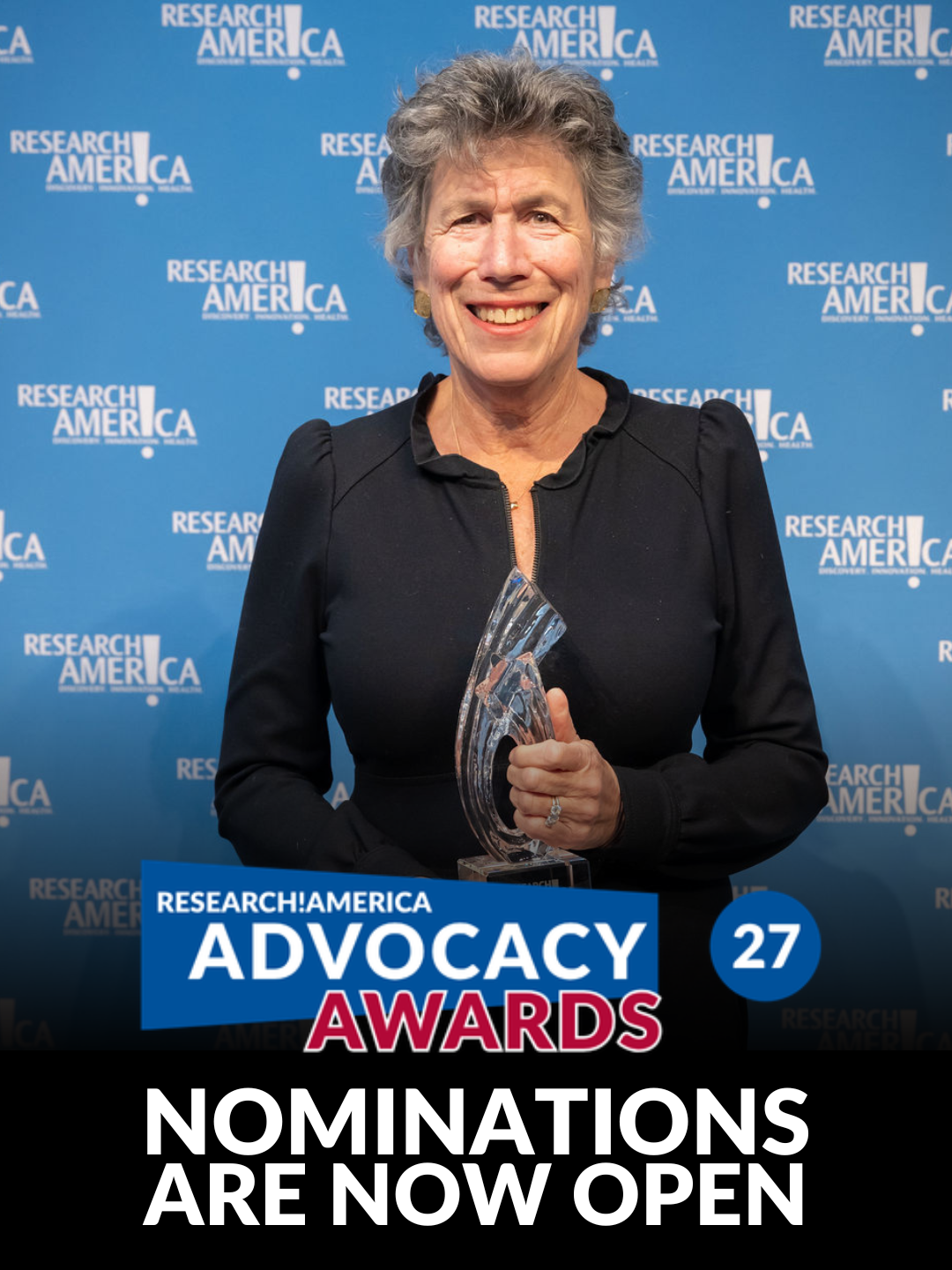
Nominate an Advocacy Champion: Now, more than ever, we need to celebrate those who are championing medical and health research and innovation in America. Who will be the next Research!America Advocacy Award honorees? Our Advocacy Awards recognize individuals and organizations whose commitment to advocacy for research and innovation has advanced medical, public health, and scientific progress in profoundly important ways. Take a look at the award descriptions and submit your nominations now. The deadline is Friday, July 17.
GHTC Innovating for Impact Awards: Nominations are now open for the Global Health Technologies Coalition’s 2026 Innovating for Impact Awards. These awards recognize the research partnerships and congressional leaders whose work helps turn breakthrough science into lifesaving global health technologies. Nominate a research partnership or Member of Congress and help recognize those driving progress against the world’s greatest global health challenges. Nominations close July 31. Learn more here.
Support Our Advocacy Work: Your support is critical to our advocacy efforts. Research!America is working every day to ensure our nation’s discovery, development, and innovation ecosystem not only survives, but thrives. Working together, we can make medical and public health, as well as overall science and technology progress, a higher national priority. Donate now.