

Midterm Election: Before and After
The run-up to elections puts members of Congress into more discussions with their constituents than at any other time of year. If you have not had a chance, now is an important time for you to make your voice heard on medical research and public health. One issue that deserves continued attention is the proposed OMB rule, which could drastically slow medical research at the expense of patients and U.S. economic competitiveness.
After the election, members will be making their decisions on legislation for the lame-duck session, and it’s important that they don’t forget about us. The National Council of Nonprofits is organizing a national Day of Action on Nov. 10. The day focuses us to contact our members of Congress and post on social media about OMB’s proposed rule and its impact on federal grantmaking. You can also utilize our Fall Advocacy Guide to contact your representative while they are in their home district. Use these opportunities to state the case for medical research.
Speaking of Federal Grantmaking… The National Science Foundation (NSF) ended FY26 with more than $1 billion in research funding left unspent. NSF spent $6.4 billion on research in FY26, down from $8.3 billion in FY25, according to AIP and Grant Witness. AHRQ also ended FY26 with funding left on the table after grantmaking slowed dramatically, and on Sept. 25 the administration proposed rescinding $28 million that Congress had already appropriated to the agency.
The picture at NIH is different: The Institutes and Centers reportedly spent all of the FY26 extramural budget. However, The Scientist and Grant Witness reported that NIH had issued approximately 61,000 awards by late September, the fewest by that point in six years. Increased use of upfront multi-year funding contributed to the lower number of awards.
Taken together, these developments show continued ferment in the federal grantmaking landscape. The administration is not waiting for the CR deadline of Dec. 11; federal grantmaking is in the crosshairs now, making continued advocacy to protect medical research that much more important.
Russ’s Corner
Russ’s Corner will return next week.
RFI Roundup: Federal agencies continue to seek public input on policies affecting research and grantmaking. Responding to requests for information (RFIs) is an opportunity to share your expertise and help inform federal policy decisions.
- Recently Closed: Proposed Changes to Reporting Outcomes from NIH Peer Review: NIH sought input on proposed changes to how peer review outcomes are reported to applicants. The comment period closed on Oct. 13. Research!America submitted comments outlining our recommendations.
- Still Open: Opportunities to Reduce Administrative Burden in NIH Extramural Research: NIH is seeking specific, actionable recommendations to improve the efficiency of the NIH grants process. Responses are due Dec. 8.
Science Policy for Early-Career Scientists: The Scientist Network for Advancing Policy (SNAP) Coalition has launched SciPol 101, a free, open-access curriculum designed to educate and empower scientists to engage in science policy and advocacy. The five-module course covers the basics of science policy, how government works, writing for science policy, science communication, and science diplomacy. The materials are designed for students and emerging university science policy groups but are available to anyone looking to strengthen their science policy and advocacy skills.
BARDA Discussion: Join us on Thursday, Oct. 29, from 1 p.m. to 2 p.m. for a Zoom fireside chat with Gary Disbrow, Ph.D., Deputy Assistant Secretary and Director of the Biomedical Advanced Research and Development Authority (BARDA). We asked Disbrow to cover BARDA’s current priorities as it works to strengthen our nation’s preparedness for public health and medical emergencies. Register here.
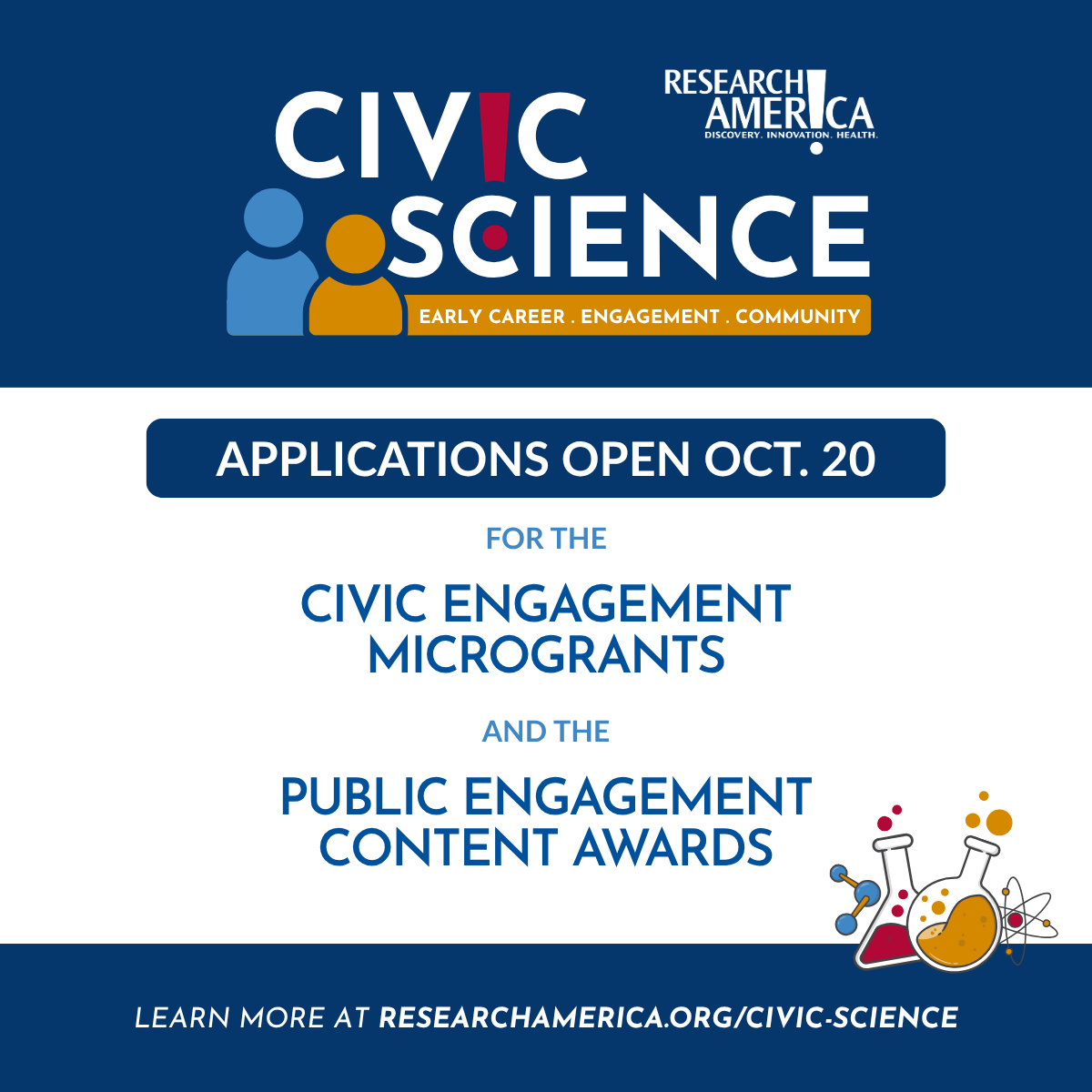 Microgrants for Early-Career Researchers Opening Soon: Research!America will start accepting applications on Oct. 20 for the 2026-2027 Civic Science Microgrants and Awards Program. Each year, we award microgrants up to $4,000 to groups of early-career researchers who have innovative ideas that connect scientists with public audiences through community-focused projects. There are also individual awards up to $5,000 for developing open-access curricula that strengthen scientists’ public engagement skills. Read about the great work done by previous civic science grant award winners, including one recently profiled in the Chicago Tribune, and see these social media posts. Applications close on Nov. 20.
PCORI Congressional Science Fair: Join the Patient-Centered Outcomes Research Institute (PCORI) for its Fourth Annual Congressional Science Fair on Capitol Hill on Wednesday, Oct. 21, from 11 a.m. to 1 p.m. in the Kennedy Caucus Room (Russell 325). Meet researchers and community partners working on PCORI-funded projects, and learn how their work is improving health outcomes across the nation. Lunch will be provided. For more information, visit the event’s webpage.
Join Research!America: If you haven’t already, join our multi-sector alliance! The membership process is straightforward, the benefits are compelling, and your participation informs and intensifies our community’s influence on and off Capitol Hill. Email Associate Director of Membership and Development Operations Donald Cook for more information.