

Engagement Influences the Outcome
The House Appropriations Committee voted along party lines late Tuesday to advance its FY27 Labor-HHS funding bill. We thank House Appropriations Committee Chairman Tom Cole (R-OK), Committee and Subcommittee Ranking Member Rosa DeLauro (D-CT), and Subcommittee Chairman Robert Aderholt (R-AL) for providing increased funding for NIH and language supportive of the Institutes. Here is the bill text and report language. Read our full statement here.
The bill would:
- Increase NIH funding by $100 million to $47.3 billion.
- Not restructure NIH or cut or eliminate funding for any Institute or Center.
- Limit the NIH’s use of multi-year funding to FY25 levels.
In contrast to these positive steps, the bill would make deep cuts to the CDC and essentially eliminate the Agency for Healthcare Research and Quality (AHRQ) and Patient-Centered Outcomes Research Institute (PCORI).
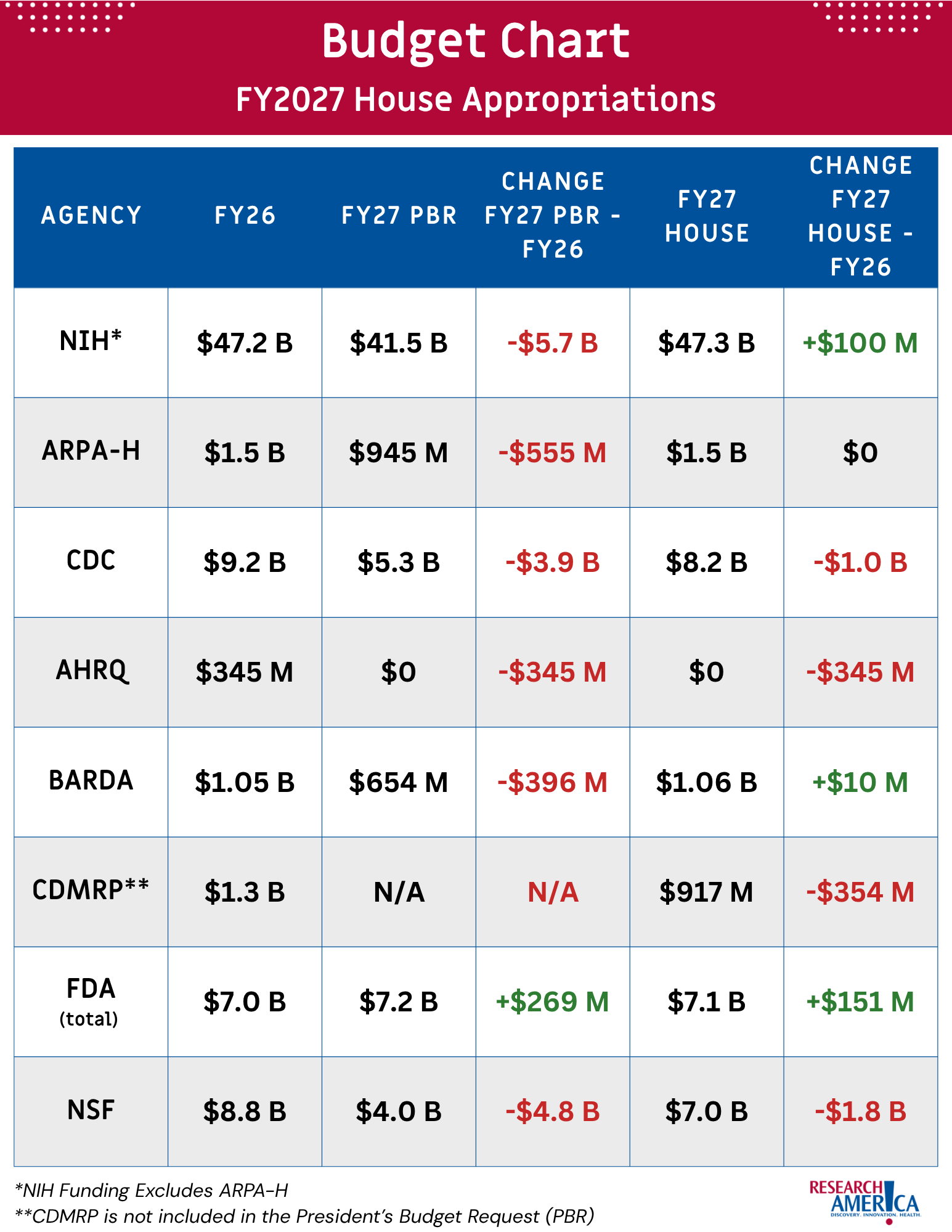 These agencies and others are featured on our updated budget chart here.
The appropriations process is far from over. The Senate has yet to release its Labor-HHS bill, and negotiations will continue in the months ahead. The House bill shows that engagement can influence the outcome, and there is still time to shape the final package. Advocates must continue ramping up our efforts in support of these drivers of critical research. We cannot take our foot off the gas!
More on Appropriations: The House Defense Appropriations Subcommittee advanced its FY27 spending bill, proposing $916.5 million for the Congressionally Directed Medical Research Programs (CDMRP). While this is below the FY26 enacted level of $1.27 billion, it is significantly higher than last year’s initial House proposal of $700 million.
The full House Appropriations Committee is scheduled to consider the Defense bill on June 24 (watch here), when additional details and accompanying report language are expected to be released.
Russ’s Corner
Biomedical research – and federally funded scientific research more broadly – is under threat from many sides. First, as detailed in last week’s letter, the Office of Management and Budget (OMB) released a proposed rule that would place research decisions in the hands of political appointees, not scientists. It would allow scientific research to be upended with each presidential election, and it would restrict publication of scientific studies. This proposed rule is not how the U.S. fuels advances in science or cures for diseases, it’s not how we ensure that we have the best scientific workforce in the world, and it’s not how we compete with China.
Second, the House budget bill for Labor-HHS calls for a modest increase in NIH funding and largely rejects an earlier budget proposal calling for deep cuts there. Other provisions, too, reflect bipartisan support for NIH, for which we are grateful. But the bill would eliminate PCORI and AHRQ, and take an ax to CDC’s budget. Here is one key sentence in the House funding bill: “It is equally vital for U.S. competitiveness that the NIH remains the world pioneer in basic scientific and biomedical research.” We couldn’t agree more, and would add that translating that research into American health requires strength at agencies like CDC, AHRQ, and PCORI. Additionally, a strong NSF (covered in other legislation) also feeds into the competitiveness and pioneering that the House bill values.
Finally, it appears that grants are being awarded at a slower pace than the historical average. While NIH Director Jay Bhattacharya has pledged to spend the entire grant budget this fiscal year, and he and his team did accomplish that last year, a reduced pace of award-making is disruptive and slows progress toward diagnostics, treatments, and cures.
As our community speaks up, we will be more effective if we don’t appear to portray every aspect of the status quo ante as perfection. We all probably have ideas for how the scientific enterprise can be improved, how federal agencies and the grant process itself could be made better. Eliminating entire agencies or portions of agencies is not the way to make those improvements. Substituting political judgment for scientific judgment – and changing that judgment every four years – is not how to improve the enterprise or get better outcomes for Americans. We should be clear about that in our advocacy.
We have work to do – all of us collectively and each of us individually – in the coming weeks and months. We must make substantive comments on the proposed rule and work with elected leaders to try to stop its overreach. We must educate lawmakers on the value of the entire scientific enterprise, particularly around the process of peer review, the need for robust NIH funding, and the contributions of other parts of the enterprise. And we must keep our eye on the rate of grantmaking.
Research!America will continue to bring us together to share information and plan responses to address our current environment. There is strength in collective action as well as individual action, and we want to make that as easy as possible for all of us.
Russ
P.S. We want your feedback to make this weekly letter everything it needs to be today. Please click this link for a short survey.

Crafting Public Comments for OMB’s Proposed Rule: Join us on Wednesday, June 17, at noon ET for an important webinar discussing the basics of submitting comments in response to OMB’s proposed rule on Regulation For Federal Financial Assistance. We are pleased to host Mark Barnes and Leslie Thornton from Ropes & Gray, and Yvette Seger, Ph.D. for this interactive discussion. Register here.
Speaking of Public Comments… NIH is seeking public input on a proposed policy that would cap the number of Research Project Grants (RPGs) that a single principal investigator can hold simultaneously. Comments are due by Aug. 3. More information can be found here.
Federal Appointments: John H. Powers III, M.D. has been named Acting Director of the National Institute of Allergy and Infectious Disease (NIAID). Previously, Dr. Powers was Principal Senior Advisor to the Director of NIAID and Director of Collaborative Research with Leidos Biomedical Research in support of the Office of the Director at NIAID. Steven Schiff, M.D., has been named Director of the Fogarty International Center. Dr. Schiff has more than 40 years of experience as a pediatric neurosurgeon and global health researcher at Yale University.
Hill Briefing on Genetically Targeted Technologies: On Tuesday, June 23, we are holding a special congressional briefing looking at the life-changing potential of Genetically Targeted Technologies (GTTs) through the lens of the patients these technologies serve. This breakfast briefing will be held from 8:30 a.m. to 10 a.m. at the Rayburn House Office Building, Room 2060. If you’ll be in the D.C. area and want to attend this in-person briefing, register here.
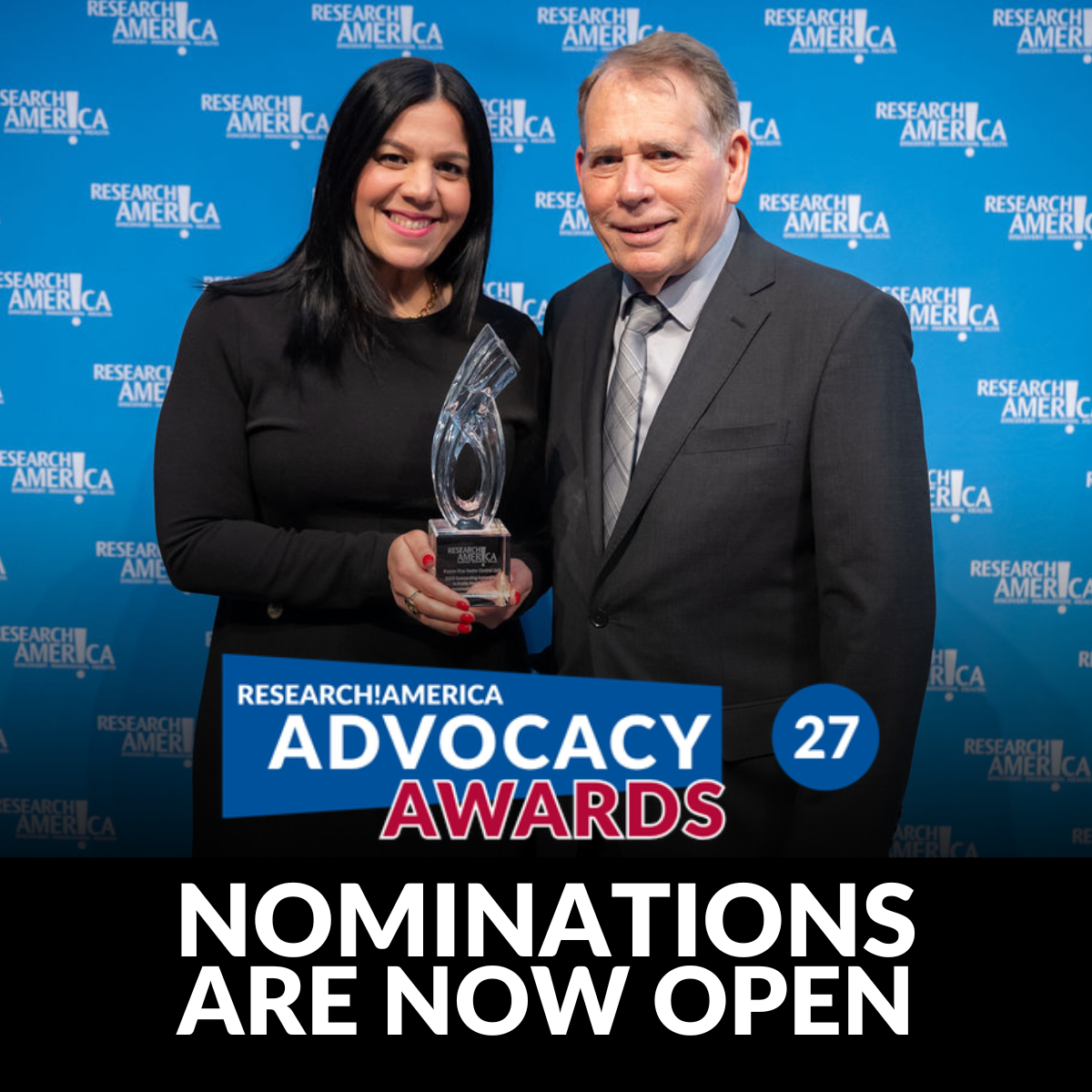
Nominate an Advocacy Champion: Now, more than ever, we need to celebrate those who are championing medical and health research and innovation in America. Who will be the next Research!America Advocacy Award honorees? Our Advocacy Awards recognize individuals and organizations whose commitment to advocacy for research and innovation has advanced medical, public health, and scientific progress in profoundly important ways. Take a look at the award descriptions and submit your nominations now. The deadline is Friday, July 17.
Support Our Advocacy Work: Your support is critical to our advocacy efforts. Research!America is working every day to ensure our nation’s discovery, development, and innovation ecosystem not only survives, but thrives. Working together, we can make medical and public health, as well as overall science and technology progress, a higher national priority. Donate now.